



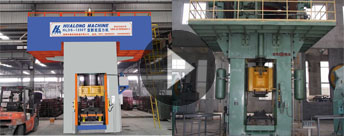
Precision Cold Forging Presses The Backbone of Superior Fasteners
Author: haloong Time: 2025-12-02 09:17:31
In the intricate ecosystem of advanced manufacturing, fasteners serve as the unsung heroes that hold modern industries together—from the high-stress components of new energy vehicles to the precision structures of aerospace engineering. The performance of these small yet critical parts is directly shaped by the manufacturing equipment that produces them, and cold forging presses stand out as the cornerstone of creating fasteners with exceptional strength, precision, and reliability. As the global fastener market marches toward a projected value of 167.519 billion yuan by 2025, the role of advanced cold forging technology in driving industrial upgrading has become increasingly prominent.
The core advantage of cold forging presses lies in their ability to transform metal materials through plastic deformation at room temperature or near-room temperature, a process that fundamentally enhances the mechanical properties of fasteners. Unlike traditional machining methods that remove material and disrupt metal grain structures, cold forging preserves the integrity of metal fibers, compacts internal microstructures, and induces work hardening—resulting in a 10% to 20% increase in tensile strength compared to cut fasteners. Modern cold forging presses can exert pressures ranging from 500 to 2000 MPa, forcing metals to flow precisely into pre-designed die cavities and forming complex shapes such as high-strength bolts and special-shaped rivets in one or multiple stages.
Precision and efficiency have become the dual pillars of contemporary cold forging press technology. Leading equipment now achieves production speeds exceeding 500 pieces per minute, a 2.5-fold increase compared to a decade ago, while controlling dimensional accuracy within 0.02 millimeters—meeting the stringent IT6-IT9 tolerance standards. This level of precision translates to surface roughness as low as Ra 0.4-3.2 μm, minimizing the need for secondary processing and significantly reducing production cycles. For automotive applications, which account for 45% of total fastener demand, such efficiency is transformative: cold forging presses enable mass production of high-strength bolts that withstand the rigorous demands of electric vehicle powertrains, where reliability directly impacts safety and performance.
The evolution of cold forging presses is also marked by intelligent upgrading and environmental sustainability. With equipment connectivity rates reaching 60%, real-time data collection and remote monitoring have become standard, reducing unplanned downtime by 40% through predictive maintenance. Energy-saving technologies have cut power consumption by over 30% compared to older models, while noise levels are controlled below 75 decibels—fully complying with EU environmental standards. These advancements not only lower production costs but also align with the global manufacturing trend toward green and intelligent practices.
In high-end application fields, the impact of advanced cold forging presses is particularly notable. In aerospace, they support the production of high-precision special fasteners, with domestic equipment penetration rising to 58% in 2025 and playing a key role in domestic large aircraft projects. In the electronics industry, micro cold forging presses create precision connectors with minimal material waste, leveraging material utilization rates of 85-95%—a stark contrast to the 50-70% efficiency of traditional machining. This combination of performance, precision, and sustainability positions cold forging presses as indispensable tools in the production of high-value fasteners.
As manufacturing continues its transition toward high quality, cold forging presses will remain at the forefront of innovation. Future developments will focus on further enhancing precision, integrating AI-driven control systems, and expanding applicability to more advanced materials. For fastener manufacturers, investing in advanced cold forging technology is not just a choice to improve product quality—it is a strategic decision to gain a competitive edge in the global market. In the end, the strength of industries worldwide will continue to rely on the superior fasteners forged by these remarkable machines.


