



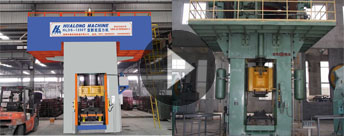
Servo Presses: Wide-Ranging Applications and Transformative Impact in the Refractory Materials Industry
Author: haloong Time: 2025-12-18 12:59:43
The refractory materials industry serves as a cornerstone for numerous high-temperature industrial sectors, including steel, cement, glass, and non-ferrous metal smelting. These materials, which must withstand extreme heat, corrosion, and mechanical wear, demand precise, efficient, and consistent manufacturing processes. In recent years, servo presses have emerged as game-changing equipment in this field, revolutionizing production paradigms with their superior performance characteristics. This article explores the extensive applications of servo presses in the refractory materials industry, highlighting their role in enhancing product quality, optimizing production efficiency, and promoting sustainable development.
One of the primary advantages of servo presses in refractory production lies in their exceptional precision and controllability. Unlike traditional mechanical presses, servo presses utilize advanced servo motor technology to drive the ram movement, enabling real-time adjustment of pressure, speed, and displacement throughout the pressing process. This level of control is crucial for manufacturing refractory products with complex shapes and strict dimensional tolerances, such as refractory bricks, tiles, and custom-shaped components used in industrial furnaces. For instance, in the production of high-alumina refractory bricks, servo presses can ensure uniform compaction of the raw material mixture, eliminating internal defects such as pores and cracks that often occur with conventional pressing methods. The result is a final product with higher density, better mechanical strength, and improved resistance to high-temperature creep, thereby extending the service life of industrial furnaces and reducing maintenance costs.
In addition to improving product quality, servo presses also significantly enhance production efficiency and flexibility in the refractory materials industry. The servo-driven system allows for faster cycle times compared to mechanical presses, as the ram can accelerate and decelerate rapidly without the limitations of mechanical linkages. Moreover, servo presses can easily switch between different production recipes by simply adjusting parameters in the control system, making them ideal for small-batch, multi-variety production. This flexibility is particularly valuable in today's market, where refractory manufacturers are increasingly required to meet customized demands from different industrial sectors. For example, a single servo press can be used to produce both magnesia-carbon refractory bricks for steelmaking converters and silica refractory tiles for glass melting furnaces, with minimal downtime for retooling. Furthermore, the energy efficiency of servo presses is another key benefit. Unlike mechanical presses that consume a constant amount of energy regardless of the load, servo presses only draw power when the ram is in motion, reducing energy consumption by 30% to 50% in typical refractory production scenarios. This not only lowers production costs but also aligns with the global trend of energy conservation and emission reduction.
The application of servo presses also contributes to the sustainable development of the refractory materials industry by reducing material waste and improving process stability. The precise pressure control of servo presses ensures that the raw material mixture is used more efficiently, minimizing the amount of scrap generated during production. In contrast, traditional pressing methods often result in over-pressing or under-pressing of the raw materials, leading to a higher rejection rate. Additionally, the stable and consistent pressing process provided by servo presses reduces the variability in product quality, further reducing waste. Furthermore, servo presses are equipped with advanced monitoring and diagnostic systems that can detect potential issues such as abnormal pressure fluctuations or raw material inconsistencies in real time. This proactive monitoring allows manufacturers to take corrective actions promptly, preventing costly production disruptions and ensuring continuous, stable operation.
Looking to the future, the application of servo presses in the refractory materials industry is expected to expand even further as technology continues to advance. With the integration of artificial intelligence (AI) and Internet of Things (IoT) technologies, servo presses will become more intelligent and autonomous. For example, AI algorithms can analyze production data to optimize pressing parameters automatically, further improving product quality and production efficiency. IoT connectivity will enable remote monitoring and control of servo presses, allowing manufacturers to manage production processes from anywhere, reducing operational costs and improving responsiveness to market changes. Additionally, the development of servo presses with larger tonnages and higher precision will enable the production of larger and more complex refractory components, meeting the growing demands of large-scale industrial projects such as super-large blast furnaces and waste incineration plants.
In conclusion, servo presses have become an indispensable piece of equipment in the refractory materials industry, thanks to their exceptional precision, efficiency, flexibility, and energy-saving characteristics. Their wide-ranging applications have transformed the way refractory products are manufactured, enabling the production of high-quality, reliable products that meet the stringent requirements of modern high-temperature industrial processes. As technology continues to evolve, servo presses will play an even more critical role in driving innovation and sustainable development in the refractory materials industry, helping manufacturers stay competitive in an increasingly globalized market. The adoption of servo press technology is not just a trend but a necessary step for refractory manufacturers looking to improve their operational efficiency, reduce costs, and meet the growing demand for high-performance refractory materials.


