



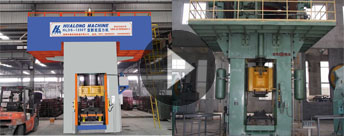
How Precision Forging Presses Improve the Durability and Performance of Photovoltaic Hardware
Author: haloong Time: 2026-01-06 09:24:36
The global photovoltaic (PV) industry is scaling rapidly, driven by the urgent need for clean energy. Behind the steady operation of PV power plants lies a critical foundation: the durability and performance of PV hardware—components like brackets, fasteners, and tracking system joints. Precision forging presses, as advanced manufacturing equipment, are reshaping the production of these key parts, directly elevating the reliability and efficiency of PV installations.
PV hardware operates in outdoor environments year-round, exposed to extreme temperatures, strong winds, and corrosive conditions. Traditional manufacturing processes (such as casting or stamping) often result in parts with uneven material structure, hidden internal defects, or insufficient mechanical strength—issues that lead to premature wear, deformation, or even failure. Precision forging presses address these gaps by applying controlled, high-pressure force to metal blanks. During the forging process, the metal’s grain structure is refined and aligned along the stress direction of the part, eliminating porosity and shrinkage. This creates components with higher tensile strength, fatigue resistance, and impact toughness—qualities that enable PV hardware to withstand long-term environmental stress.
Take PV brackets as an example: these structures bear the weight of solar panels and must maintain stability under wind loads. Precision forging presses produce bracket components with tight dimensional tolerances (often within ±0.05mm) and uniform material density. The enhanced structural integrity means brackets can support heavier panel loads without bending, while the precise fit of forged joints reduces friction and wear during tracking system adjustments. This not only extends the hardware’s service life but also ensures the tracking system operates smoothly, maximizing the panels’ light-receiving efficiency.
Beyond durability, precision forging presses also boost the performance of PV hardware through material optimization. By shaping parts in a single, high-precision operation, these presses minimize material waste (with utilization rates reaching 90% or higher, compared to 60-70% for machining). This reduces production costs while allowing manufacturers to use high-strength alloys (e.g., aluminum-magnesium alloys) more efficiently—materials that balance weight reduction and mechanical performance, further improving the overall efficiency of PV systems.
In the context of the PV industry’s shift toward large-scale, high-efficiency installations, the role of precision forging presses will only grow. As hardware requirements become more stringent (e.g., lighter weight, higher load capacity), these presses will continue to evolve—integrating intelligent control systems, adaptive pressure adjustment, and real-time quality monitoring. By producing more durable, high-performance PV hardware, precision forging presses are not just supporting the growth of the PV sector; they are laying a solid foundation for the long-term stability and sustainability of global clean energy infrastructure.


