



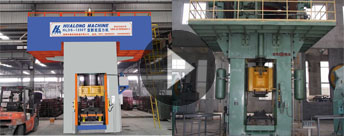
High-Efficiency Precision Forging Press: Crafting High-Strength Shaft Forgings for Industrial Applications
Author: haloong Time: 2026-01-10 08:56:38
In the landscape of modern industrial manufacturing, high-strength shaft forgings stand as the backbone of critical equipment across sectors such as heavy machinery, wind power generation, automotive engineering, and aerospace. These components are required to withstand extreme loads, high rotational speeds, and harsh operating environments, making their quality and performance non-negotiable for the stable operation of entire systems. Against this backdrop, the high-efficiency precision forging press has emerged as a game-changing piece of equipment, redefining the production standards of high-strength shaft forgings through its unparalleled pressure control, forming precision, and production efficiency.
The core competitiveness of the high-efficiency precision forging press lies in its ability to deliver precise, controllable, and uniform pressure during the forging process. Unlike conventional forging equipment that often results in uneven metal flow and inconsistent grain structure, this advanced press adopts a servo-driven control system that adjusts pressure and stroke in real time according to the forming characteristics of shaft forging blanks. This precise control ensures that the metal billet undergoes uniform plastic deformation throughout the forging cycle, effectively eliminating defects such as internal cracks, porosity, and uneven wall thickness that are common in traditional forging processes. For high-strength alloy steel shaft forgings, such as those made from 42CrMo and 34CrNiMo6, this uniform deformation refines the grain structure of the material, significantly enhancing mechanical properties such as tensile strength, yield strength, and impact toughness. Test data shows that shaft forgings produced by this press can achieve a tensile strength of over 800 MPa, with a fatigue life that is 30% longer than those manufactured by traditional methods.
In addition to superior forming quality, the high-efficiency precision forging press excels in production efficiency and material utilization, addressing two major pain points in the forging industry. Equipped with an automated feeding and discharging system, the press can realize continuous, unmanned production of shaft forgings, reducing manual intervention and production cycle time by up to 40%. Moreover, its near-net shaping capability minimizes the amount of material that needs to be removed during subsequent machining processes. For example, when producing a wind turbine main shaft forging with a diameter of 1.2 meters, the material utilization rate can be increased from 60% (with traditional forging) to 85% or higher. This not only cuts down raw material costs but also reduces machining time and energy consumption, contributing to a more environmentally friendly and cost-effective production model.
The adaptability of the high-efficiency precision forging press further expands its application scope in the production of high-strength shaft forgings. It can handle a wide range of workpiece sizes, from small automotive transmission shafts with a diameter of 50 millimeters to large marine propulsion shafts exceeding 3 meters in length. Additionally, it is compatible with various high-performance materials, including carbon steel, alloy steel, stainless steel, and even titanium alloys, meeting the diverse needs of different industrial sectors. In the wind power industry, for instance, it produces main shafts that can withstand the alternating loads of wind turbines operating in harsh coastal or desert environments for over 20 years. In the automotive sector, it manufactures drive shafts that meet the high-strength and lightweight requirements of new energy vehicles, helping to reduce vehicle weight and improve energy efficiency.
Quality control is another key advantage of the high-efficiency precision forging press. Integrated with real-time monitoring sensors and intelligent inspection systems, the press can track critical process parameters such as temperature, pressure, and stroke during forging, and automatically alert operators to any deviations from the preset standards. Post-forging, the shaft forgings undergo a series of rigorous testing procedures, including ultrasonic flaw detection, hardness testing, and tensile testing, ensuring that every component meets the strictest industry standards. This comprehensive quality control system guarantees the consistency and reliability of the final products, which is especially crucial for safety-critical applications in aerospace and heavy machinery.
Looking to the future, as industries continue to pursue higher performance, lighter weight, and longer service life of shaft forgings, the high-efficiency precision forging press will play an increasingly vital role. With the integration of digital twin technology and artificial intelligence, it will be able to simulate the entire forging process in advance, optimizing process parameters and predicting potential defects before production even begins. This will further improve production efficiency and product quality, while reducing development costs and time-to-market for new shaft forging products. As a cornerstone of advanced manufacturing, the high-efficiency precision forging press will continue to drive the innovation and upgrading of the high-strength shaft forging industry, supporting the sustainable development of key sectors such as energy, transportation, and aerospace.


