



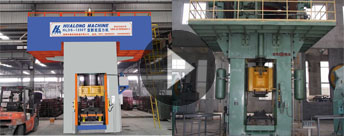
First Choice for Magnesia-Carbon/Corundum Brick Forming: Refractory-Dedicated Servo Screw Press Lays a Solid Foundation for High-End Refractories
Author: haloong Time: 2026-01-24 13:18:31
Magnesia-carbon bricks, boasting excellent molten slag erosion resistance and high thermal conductivity, serve as the core lining material for harsh working conditions such as the slag lines of converters and electric furnaces. Corundum bricks, with their high refractoriness and strong mechanical strength, are widely applied in high-temperature scenarios including cement kilns and refining furnaces. The performance of both bricks hinges directly on density control, structural uniformity and dimensional accuracy during the forming process. With over 40 years of in-depth engagement in the forging and pressing equipment sector, Zhengzhou Haloong Machinery Co., Ltd. has developed a servo screw press dedicated to refractory materials based on the core forming process requirements of magnesia-carbon and corundum bricks. Endowed with the core advantages of flexible pressure control, long-term stability, energy efficiency and intelligence, this press has become the preferred equipment for high-end refractory enterprises to break through production bottlenecks.
Magnesia-carbon bricks feature a large thermal expansion coefficient difference between magnesia and graphite, with graphite prone to floating upward; corundum bricks involve complex particle gradation. Both impose extremely high requirements on the adaptability of forming pressure, and traditional equipment struggles to meet the dual demands of sufficient exhaust and dense forming. Zhengzhou Haloong's refractory-dedicated servo screw press is equipped with permanent magnet synchronous servo direct drive technology, abandoning the traditional flywheel-clutch structure and achieving zero redundant loss in the transmission chain. It can digitally preset a flexible pressure curve of "light pressing for exhaust first, heavy pressing for forming later", perfectly adapting to the forming procedures of both bricks. Combined with a 23-bit high-precision encoder and a closed-loop control system, the energy fluctuation is accurately controlled within ±0.5%, and the slide stroke precision reaches ±0.05mm. The press can optimize pressure parameters for the 10%-20% golden carbon content range of magnesia-carbon bricks, effectively inhibiting graphite floating; at the same time, it ensures the full dense combination of corundum brick particles. As a result, the bulk density of magnesia-carbon bricks is stably maintained above 2.98g/cm³, the apparent porosity of corundum bricks is reduced to below 8%, and the product qualification rate is raised from 90% with traditional equipment to over 98%.
Refractory production involves a large amount of dust, and impurities such as magnesia and corundum powder are prone to intruding into the core components of equipment, leading to rapid precision attenuation and frequent maintenance of traditional presses. Targeting this problem, Zhengzhou Haloong adopts a fully enclosed hydrostatic lubrication system: key components such as screws, nuts and thrust bearings are placed in a thin oil circulation immersion environment, and a fully automatic forced lubrication station is matched to realize intelligent filtration and high-pressure oil supply, completely isolating dust erosion. This design extends the service life of core components by more than twice compared with traditional equipment. Meanwhile, the press adopts a split prestressed fuselage structure with high rigidity and excellent anti-unloading capacity, combined with an X-type guide rail design. It can effectively cope with the uneven stress during corundum brick forming, avoid dimensional deviation problems such as "uneven brick head and cap", ensure 24-hour continuous high-load operation without faults, greatly reduce unplanned shutdown losses, and provide stable support for the magnesia-carbon and corundum brick production lines of large steel plants.
Under the dual carbon goals, energy conservation and consumption reduction have become the core demand for the transformation of refractory enterprises. Zhengzhou Haloong's servo screw press adopts an on-demand start mode of the servo motor: the motor shuts down with no energy consumption during idle strokes such as feeding and demoulding. Compared with traditional friction presses, its comprehensive energy saving rate exceeds 55% — a single 1250T equipment can save tens of thousands of kilowatt-hours of electricity annually, with a small starting current that causes no impact on the power grid. The press can also optimize stroke parameters according to different specifications of magnesia-carbon and corundum bricks (from the conventional 115×230mm to the large 900×200mm), shorten invalid strokes, and improve production efficiency by more than 40% compared with traditional equipment. In addition, the fully enclosed structure greatly reduces transmission noise, and the absence of a hydraulic system avoids oil pollution — this not only improves the workshop operating environment but also complies with the national green factory construction standards.
Relying on over 40 years of experience in the refractory industry, Zhengzhou Haloong has formed a complete product matrix ranging from 200T to 1600T, which can be custom-optimized for different application scenarios of magnesia-carbon bricks (thermal shock resistance) and corundum bricks (erosion resistance). For high-density magnesia-carbon bricks used in converter slag lines, the pressure peak regulation is strengthened; for corundum bricks used in cement kilns, the guiding precision and mold adaptation interface are optimized. The press supports one-click switching of process parameters and is compatible with the forming of multiple product categories, realizing one machine for multiple uses and saving equipment investment costs for enterprises. It can also be equipped with an intelligent production management system to collect key parameters such as striking force and forming cycle in real time, and supports seamless connection with automatic feeding and demoulding systems, helping enterprises build semi-automated/automated production lines and reduce labor dependence.
Facing the higher requirements for forming precision, stability and energy efficiency in the high-end refractory industry, Zhengzhou Haloong will continue to increase R&D investment, focus on optimizing equipment performance for segmented fields such as special-shaped magnesia-carbon bricks and high-performance corundum bricks, and deepen the integrated empowerment model of "Equipment + Solution + Service". The company provides a full-cycle service covering demand research, scheme design, installation and commissioning, as well as operation and maintenance training.


