



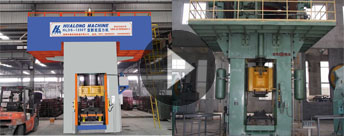
Uniform and Controllable Green Body Density Empowers the High-End Upgrade of the Refractory Industry
Author: haloong Time: 2026-02-02 14:33:58
In the forming process of refractory materials, whether the green body density is uniform and controllable directly determines the final quality and operational safety of the products. Industry practice has verified that when the coefficient of variation of green body density exceeds 1.5%, refractory products are prone to cracks, spalling and collapse during high-temperature service, with their service life shortened by more than 30%. This not only increases the replacement costs of end-user enterprises, but also may trigger potential production safety hazards. On the contrary, green bodies with uniform, controllable density and a coefficient of variation controlled below 1.5% can achieve precise control of porosity after sintering, with their thermal shock resistance times increased to more than 30, significantly enhancing the reliability and durability of refractory products.
Currently, the refractory industry still faces numerous pain points in the green body forming process: Traditional friction presses rely on mechanical transmission, featuring unstable energy release and uneven pressure transmission, which easily lead to excessive density differences between the center and edge of green bodies; ordinary hydraulic presses have slow response and cannot adapt to the dynamic process requirements of "air exhaust - compaction" in refractory forming, making it difficult to achieve precise density control; some equipment has a low degree of automation and large human operation errors, resulting in obvious density fluctuations of products in the same batch, which fails to meet the large-scale production needs of high-end refractories. Especially after the implementation of new standards such as GB/T 2999-2026 Test Method for Particle Bulk Density of Refractory Materials, the requirements for uniformity and controllability of refractory green body density have been further raised, and traditional equipment can no longer adapt to the development trend of the industry. Based on industry demands, Zhengzhou Haloong has broken through the bottleneck with technological innovation, making uniform and controllable refractory green body density the norm.
With 45 years of dedicated R&D and manufacturing of powder forming equipment, Zhengzhou Haloong has leveraged its profound industry experience and continuous technological innovation to develop the HLDS series servo screw presses. Covering various tonnages from 200T to 1600T, these presses are suitable for forming more than 100 types of refractory products such as high-alumina bricks, magnesia bricks, carbon bricks and special-shaped bricks. With the core advantages of precise pressure control, intelligent efficiency and stable durability, they have become the preferred equipment for refractory enterprises to achieve uniform and controllable green body density. The specific advantages are as follows:
Precise Digital Pressure Control for Consistent Density Uniformity
Adopting a permanent magnet synchronous servo motor direct drive design, it abandons the traditional clutch and friction disk structure. The pressing energy, striking force and striking speed can be precisely preset through digital programs, with the repeat accuracy error of energy per stroke close to zero. Tailored to the characteristics of refractory forming processes, it can flexibly set a stepped pressure application mode of "light pressing for air exhaust first, then heavy pressing for forming", effectively eliminating internal pores of green bodies and ensuring uniform density from the center to the edge and from the surface to the inner layer of green bodies. Field tests have verified that the coefficient of variation of density of refractory green bodies produced by Haloong servo screw presses can be stably controlled below 1.5%, which can accurately meet the forming density requirements of magnesia bricks (ρ=3.2g/cm³), silica bricks (ρ=2.2g/cm³) and high-alumina bricks (ρ=2.0g/cm³). Fully complying with GB/T 2997-2015 and other relevant domestic and international standards, it realizes quantitative and controllable density precision.
Flexible Forming Without Fixed Bottom Dead Center
Breaking through the structural bottom dead center limitation of traditional presses, it adopts a progressive forging mode. It can flexibly adjust pressure application parameters according to the characteristics of refractory raw materials and the shape and size of products, avoiding the problem of overload jamming caused by material size deviation or uneven temperature. Whether for mass production of regular shaped refractories or customized forming of complex products such as special-shaped bricks, honeycomb checker bricks and burner composite bricks, it can achieve uniform pressure application, avoiding insufficient local densification or overpressure cracking, ensuring the stability of density uniformity of various refractory green bodies and greatly improving the product qualification rate.
Static Pressure Transmission Structure for Long-Term Stability
Adopting a fully enclosed static pressure screw, nut and bearing transmission, a stable oil film is formed for protection during operation. Combined with a fully automatic forced lubrication system, it effectively reduces equipment wear, doubling the service life of the equipment compared with ordinary screw presses. With a short transmission chain and simple structure, it has low energy transmission loss, which can ensure that pressure is continuously and stably transmitted to all parts of the green body, avoiding density fluctuations caused by equipment operation vibration and component wear. It realizes long-term and lasting uniformity of green body density, helping enterprises stably mass-produce high-quality refractory products.
Intelligent Integration for Unmanned Production
Equipped with Haloong's intelligent production management system, it can seamlessly link with equipment such as automatic feeding, intelligent weighing and distributing, mold release agent spraying, part picking and inspection, and palletizing, building a fully automated production line from batching and forming to inspection. One-click control through digital programs enables stable production without skilled operators, effectively eliminating the impact of human operation errors on green body density. Meanwhile, it supports remote monitoring and parameter debugging via Haloong Cloud Network, collecting real-time data such as forming density and production efficiency to provide data support for density parameter optimization and production process improvement. Conforming to the global intelligent development trend of Industry 4.0, it helps enterprises realize digital and unmanned production transformation.
Energy-Saving Operation to Reduce Comprehensive Costs
The servo motor adopts an "on-demand operation" mode, starting only during forming operations and entering hibernation during processes such as feeding and demolding. It saves more than 55% energy compared with traditional friction presses, greatly reducing production energy consumption. The slider speed is extremely fast when the equipment approaches the bottom dead center, enabling forming to be completed in an instant before raw materials cool down. With short contact time with the mold, the mold temperature fluctuation is small, extending the mold service life by 30% and further compressing the comprehensive production costs of refractory enterprises. At the same time, high-density and uniform green bodies can reduce raw material loss during sintering, lower the rejection rate, indirectly saving costs and improving efficiency for enterprises.
Multiple Safety Protections for Stable Production
Equipped with dual protection devices of motor self-braking and mechanical braking, the slider automatically rises to the top dead center in case of power failure or emergency shutdown, eliminating jamming, material blocking and safety accidents. The equipment operates with low vibration and low noise, which not only ensures the personal safety of operators but also avoids green body density deviation caused by vibration, providing double protection for refractory enterprises to achieve continuous and stable density-controllable production. It has been successfully applied in large-scale projects such as the magnesia-carbon brick production line of Maanshan Iron & Steel Group, winning high recognition from customers.
As the "cornerstone" of high-temperature industries, the quality upgrade of refractory materials is directly related to the green, low-carbon development and safe production of downstream industries such as iron and steel, cement and non-ferrous metals. Uniform and controllable green body density is the core prerequisite for the upgrading of refractory products towards high-end and refined development, and also the key for refractory enterprises to break through development bottlenecks and enhance core competitiveness. Always based on the needs of the refractory industry, Zhengzhou Haloong takes technological innovation as the core driving force, devotes itself to the R&D and manufacturing of servo screw presses, continuously optimizes equipment performance and improves the service system. It not only provides efficient, stable and intelligent solutions for uniform and controllable green body density for refractory enterprises, but also relies on a professional R&D and testing center to provide customers with comprehensive services such as on-site product testing, process discussion and technical training, helping customers optimize production processes and improve product quality.


