



Precision Forming for Premium Quality · High Temperature & Corrosion Resistance
Author: haloong Time: 2026-02-06 14:30:39
Compared with ordinary refractory bricks, magnesia-carbon bricks have unique raw material characteristics: magnesia has high hardness and poor fluidity, graphite features a flake structure and strong lubricity, and coupled with the adaptability requirements for binders, their forming difficulty is far higher than that of conventional refractory materials. This imposes extremely high requirements on the pressure control precision, uniform force transmission and process adaptability of forming equipment. At present, traditional forming equipment in magnesia-carbon brick production is plagued by numerous prominent pain points, which severely restrict the industry's high-end and large-scale development: Traditional friction presses rely on mechanical transmission with unstable energy release, failing to precisely control pressing force and speed. This easily leads to insufficient air exhaust, excessive internal pores and large density deviation in magnesia-carbon brick green bodies, resulting in cracks, spalling, corner chipping and other defects after subsequent heat treatment, making the products unable to resist extreme corrosion in metallurgical working conditions; Ordinary hydraulic presses have slow response and cannot adapt to the stepped forming requirements of magnesia-carbon bricks of "light pressing for air exhaust and heavy striking for forming". In addition, uneven force transmission causes obvious density differences between the edge and center of green bodies, affecting the high-temperature service life of products and making it difficult to meet the demand for long-term and stable use of magnesia-carbon bricks in large metallurgical equipment; Some forming equipment has a low degree of automation and relies on manual parameter adjustment, which not only leads to high labor costs, but also easily results in inconsistent performance of products in the same batch due to human operation errors. This makes it hard to meet the standardization and consistency requirements of high-end domestic and foreign metallurgical markets for magnesia-carbon bricks, and is especially incompatible with the production capacity and quality demands of intelligent manufacturing projects for magnesia-carbon bricks with an annual output of ten thousand tons.
With the global green and high-end transformation of the metallurgical industry, the demand for high-efficiency, long-life and energy-saving magnesia-carbon bricks in the iron and steel industry has been rising continuously. Especially in major overseas metallurgical countries such as Europe, North America and Southeast Asia, more stringent standards have been set for the density uniformity, dimensional accuracy and service life of magnesia-carbon bricks, and traditional forming equipment can no longer adapt to the industry's development needs. Against this backdrop, relying on 45 years of equipment R&D and manufacturing experience and combining the raw material characteristics and forming process features of magnesia-carbon bricks, Zhengzhou Haloong has carried out special optimization and upgrading of servo screw presses and launched exclusive equipment adapted for the forming of magnesia-carbon bricks (including magnesia-alumina-carbon bricks, alumina-magnesia-carbon bricks, etc.). With the core advantages of precise pressure control, intelligent adaptation and high efficiency and energy saving, the equipment has become the core support for magnesia-carbon brick enterprises to break through development bottlenecks and seize the high-end market. It demonstrates the technical strength of "Haloong" as the top brand of electric screw presses, and helps enterprises solve the production capacity bottleneck of magnesia-carbon bricks and enhance product competitiveness.
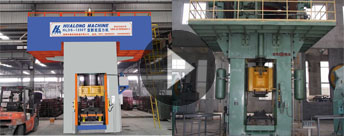
As a national patented product, Zhengzhou Haloong's servo screw press adopts the third-generation permanent magnet synchronous servo motor direct drive technology and is benchmarked against the world's high-end refractory forming equipment. Specially optimized for the raw material characteristics and forming process difficulties of magnesia-carbon bricks, it is perfectly suitable for the mass forming and customized production of various magnesia-carbon bricks. It can meet both the large-scale mass production of ordinary magnesia-carbon bricks and the precision forming of special-shaped and thick-walled high-end magnesia-carbon bricks, comprehensively solving the forming pain points of magnesia-carbon bricks, laying a solid foundation for product quality, and adapting to the upgrading needs of intelligent manufacturing production lines for magnesia-carbon bricks.
Adopting a permanent magnet synchronous servo motor direct drive design and abandoning the traditional clutch and gear transmission structures, the press realizes digital and precise control of pressing speed, pressure and stroke, with an energy repeat control accuracy of ≤±2.5%, approaching the level of the world's top servo forming equipment. It can accurately meet the compaction requirements of the "magnesia + graphite" composite raw materials of magnesia-carbon bricks. Aiming at the characteristics of poor fluidity of magnesia-carbon brick raw materials and difficult air exhaust caused by the flake structure of graphite, the equipment can preset a stepped forming process of "multiple rounds of light pressing for air exhaust and final heavy striking for forming" through programs, precisely controlling the striking force and speed of each round to fully exhaust the air inside the green body. This effectively avoids the problem of insufficient compactness caused by graphite agglomeration, ensures uniform density from the center to the edge of magnesia-carbon brick green bodies, and controls the density coefficient of variation below 1.0%. It thus effectively prevents cracks, delamination, spalling and other defects after heat treatment, greatly improves the high-temperature strength, corrosion resistance and thermal shock resistance of magnesia-carbon bricks, and extends their service life in metallurgical equipment. Meanwhile, the servo motor has a strong overload capacity, allowing a load twice the nominal pressure. It can adapt to the compaction requirements of high-hardness magnesia raw materials while ensuring the bonding stability of binders.
Breaking through the structural bottom dead center limitation of traditional presses, the equipment adopts a non-fixed bottom dead center design, eliminating the risk of equipment overload and jamming caused by raw material proportioning deviation, critical particle size difference of magnesia or uneven mixing of magnesia-carbon brick raw materials. The forming parameters can be flexibly adjusted through digital programs to adapt to the forming needs of magnesia-carbon bricks of different materials such as magnesia-alumina-carbon bricks, alumina-magnesia-carbon bricks and low-carbon magnesia-carbon bricks, as well as products of various specifications including straight bricks for converters, curved bricks for ladles and special-shaped bricks for furnace bottoms. It is especially suitable for the layered compaction forming of thick-walled magnesia-carbon bricks, ensuring consistent compactness of all parts of the green body and controlling the dimensional accuracy error within ±0.5mm. This meets the dimensional standardization requirements of high-end domestic and foreign metallurgical markets for magnesia-carbon bricks and adapts to the lining installation needs of different metallurgical equipment. At the same time, the equipment can realize free conversion of high and low speeds in a single stroke, completely simulating the precision of manual operation, further improving forming quality and reducing green body defects caused by the flake structure of graphite.
Adopting a fully enclosed static pressure screw, nut and bearing transmission structure, a stable oil film is formed for protection during operation. Combined with a fully automatic forced lubrication system, equipment wear is effectively reduced, and the service life is more than doubled compared with ordinary screw presses. The equipment can adapt to the high-intensity operation needs of large-scale magnesia-carbon brick production for a long time – especially the continuous production needs of intelligent manufacturing projects for magnesia-carbon bricks with an annual output of 50,000 tons and above. With a short transmission chain and simple structure, there are no vulnerable and consumable parts such as friction disks and gearboxes, bringing convenient later maintenance and extremely low maintenance costs. The equipment failure rate is reduced by more than 60%, ensuring continuous and stable production, reducing downtime losses and avoiding raw material waste in the production process of magnesia-carbon bricks. Meanwhile, the equipment runs smoothly with no vibration at low speed, avoiding green body density deviation and graphite delamination caused by vibration, further ensuring forming precision and conforming to the process requirements for the precision forming of magnesia-carbon bricks.
Equipped with the independently developed intelligent production management system of Zhengzhou Haloong and standardized industrial communication interfaces, the press can seamlessly link with upstream and downstream equipment such as automatic feeding systems, raw material proportioning systems, mold release agent spraying equipment, automatic part-picking robots and green body inspection equipment. It realizes full-process automatic and digital management and control of magnesia-carbon brick forming, adapts to the upgrading needs of intelligent manufacturing production lines for magnesia-carbon bricks, and is benchmarked against the intelligent level of the world's first automatic production line of servo direct drive numerical control screw presses for refractory forming. The equipment can receive real-time data such as upstream raw material proportioning and feeding speed, and automatically adjust forming parameters to avoid parameter deviations caused by manual intervention, adapting to the production needs of different graphite addition amounts and different critical particle sizes of magnesia; After forming is completed, it sends instructions to the part-picking robot synchronously to achieve seamless connection between demolding and part picking, reducing the damage rate of magnesia-carbon brick green bodies (to below 0.5%) and avoiding green body corner chipping caused by the flake structure of graphite. In addition, a built-in high-precision data acquisition module with a sampling frequency of up to 100 times per second can collect key data in the forming process in real time and upload it to the central control system to form a full-process quality traceability system, ensuring that each batch of magnesia-carbon bricks is traceable and controllable, and greatly increasing the product qualification rate to over 99%. Besides, the system supports remote monitoring and parameter debugging, facilitating the off-site production management of domestic and foreign customers. It is simple and easy to operate, and the one-button operation does not require skilled operators, helping enterprises achieve "staff reduction and efficiency improvement".
Relying on the core advantages of servo direct drive technology, the equipment realizes the "on-demand start and hibernation energy saving" mode, operating only during forming operations and entering hibernation during processes such as feeding, demolding and mold cleaning with no invalid power consumption. It saves more than 60% energy compared with traditional friction presses, with a motor efficiency of ≥95%, greatly reducing the energy consumption costs of magnesia-carbon brick enterprises – it is especially suitable for energy saving needs in large-scale production scenarios and conforms to the global industry trends of green metallurgy and low-carbon production. Meanwhile, the slider speed is extremely fast when the equipment approaches the bottom dead center, enabling forming to be completed in an instant before the magnesia-carbon brick raw materials and binders cool down. The short contact time with the mold reduces mold wear and extends the mold service life by more than 30%, further compressing the comprehensive production costs of enterprises. In addition, the equipment operates without transmission noise, greatly improving the workshop working environment, conforming to the domestic and foreign industry trends of green production and low-carbon development, and meeting the Emission Standard of Air Pollutants for Refractory Industry (GB 41618-2022) and overseas environmental protection standards, helping magnesia-carbon brick enterprises realize the transformation to green production.
As a core category of high-end refractory materials, magnesia-carbon bricks are the "protective armor" for high-temperature equipment in the metallurgical industry. Their quality is directly related to the safe production, green transformation and efficiency improvement of the global metallurgical industry, and the upgrading and iteration of forming equipment is the core driving force for promoting the high-end, standardized and large-scale development of the magnesia-carbon brick industry. At present, the refractory industry is transforming towards the direction of "high efficiency, long life, low carbon and intelligence". As a core product of metallurgical refractories, the intelligent and precise upgrading of magnesia-carbon brick forming processes has become the key to the industry's development.


