



Unveiling the Secret to Enhancing the Density of Refractory Products - Zhengzhou Haloong Servo Screw Press, Laying the Foundation for High-Quality Refractory Materials
Author: haloong Time: 2026-02-28 14:07:40
The density of refractory products is essentially the degree of tight bonding of raw material particles, which is directly related to the porosity, strength, and service performance of the product. Industry data shows that for every 10% increase in the density of refractory products, the number of thermal shock cycles can increase by more than 25%, the erosion resistance can improve by 30%, and the service life can be extended by 40%. Conversely, refractory materials with insufficient density and excessive porosity are prone to cracking, spalling, and collapse at high temperatures, not only increasing the frequency of replacement but also potentially causing production safety hazards.
Currently, refractory enterprises at home and abroad generally face three major pain points in density improvement: First, traditional friction presses and ordinary hydraulic presses have low pressure control accuracy and unstable energy release, resulting in incomplete expulsion of internal pores in the green body, making it difficult to achieve the required density, and the density distribution is uneven, with a density difference of more than 15% between the edge and the center. Second, the forming process does not match the characteristics of the raw materials. Different types of refractory materials (such as high alumina, magnesia, carbon, etc.) have different particle size distributions, and traditional equipment cannot flexibly adjust the pressing parameters, easily leading to problems such as over-pressing and corner breakage or under-pressing and pore formation. Third, there is excessive manual intervention during the forming process, with large parameter fluctuations, resulting in poor density consistency within the same batch of products, making it difficult to meet the standardized production requirements of high-end refractory materials. With the implementation of international rules such as the EU's carbon border adjustment mechanism and the rapid growth of domestic demand for high-end refractory materials, density improvement has become a key for refractory enterprises to break through development bottlenecks and capture market share.
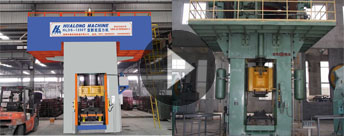
Zhengzhou Haloong's HLDS series servo screw press, as a national patent product, adopts the third-generation permanent magnet synchronous servo motor direct drive technology, aligning with the global high-end refractory forming equipment standards, focusing on the core demand for density improvement in refractory materials. Through technological innovation, it addresses industry pain points and becomes a "key weapon" for enhancing the density of refractory products. It is suitable for the forming needs of various refractory materials, including standard refractory bricks, special-shaped bricks, honeycomb lattice bricks, and large prefabricated blocks, helping domestic and foreign refractory enterprises achieve the production goals of "high density, high consistency, low cost, and high efficiency".
It overcomes the shortcoming of lagging pressure control in traditional equipment by adopting a permanent magnet synchronous servo motor direct drive design, eliminating traditional clutches and gear transmission structures. The transmission chain is short and energy loss is low. The pressing energy can be precisely preset through a digital program, with a repeat control accuracy of ≤±1%, far exceeding the industry average. It can achieve a stepwise forming process of "light pressure for exhaust first, then heavy pressure for compaction", thoroughly expelling internal pores in the green body and allowing raw material particles to bond tightly, enhancing the density of refractory materials from the source. Compared with traditional equipment, Haloong's servo screw press can increase the density of refractory products by 12% to 18%, with a density variation coefficient controlled below 1.5%, ensuring uniform density from the center to the edge of the green body, effectively reducing the porosity to below 15%, significantly improving the high-temperature stability and erosion resistance of refractory products, and meeting international high-end refractory density standards. At the same time, the equipment has a non-fixed bottom dead center design, allowing flexible adjustment of the pressing force and stroke according to the particle size distribution of the raw materials, avoiding over-pressing or under-pressing, eliminating density inhomogeneity and corner breakage, and laying a solid foundation for density improvement.
It adopts a fully enclosed static pressure screw, nut, and bearing transmission structure, forming a stable oil film during operation for protection, combined with a fully automatic forced lubrication system, effectively reducing friction losses during transmission. The equipment wear is reduced by more than 70% compared to ordinary screw presses, and the service life is increased by more than double. The transmission structure operates smoothly with low vibration and noise, enabling 24-hour continuous stable production, avoiding fluctuations in pressing parameters due to equipment vibration or failure, ensuring density consistency within and between batches of refractory products, and solving the pain point of "large batch differences" in traditional equipment. In addition, the equipment is equipped with a dual braking protection system. When there is a power outage or an emergency shutdown, the slider automatically rises to the upper limit point, eliminating the risk of jamming and safety accidents, providing a double guarantee for the stable improvement of density, and meeting the needs of large-scale and standardized production. It helps enterprises build a brand of high-end refractory products.
It is equipped with an intelligent production management system independently developed by Zhengzhou Haloong, with standardized industrial communication interfaces. It can be seamlessly connected with upstream and downstream equipment such as automatic feeding systems, raw material proportioning systems, and green body detection equipment, achieving full-process automation and digital control of refractory forming. The system can automatically adjust the pressing parameters, the number of strikes, and the speed according to the raw material characteristics of different types of refractories (high alumina, magnesia, carbon, silica, etc.), achieving "one machine for multiple uses". There is no need to purchase additional equipment to meet the density improvement requirements of different types of refractories. For the forming difficulties of large and irregular refractories, a dedicated pressing mechanism can be customized to ensure uniform pressure transmission to all parts of the green body, solving the industry pain points of uneven density and easy deformation of large refractories, and helping enterprises expand the product matrix of high-end refractories. At the same time, the system supports remote monitoring and parameter adjustment, making it convenient for domestic and foreign customers to control production from a distance. The operation is simple and easy to learn, and stable production can be achieved without skilled operators, reducing density fluctuations caused by human intervention and further improving density consistency.
It adopts a "start on demand, sleep for energy saving" mode. The servo motor only operates during the forming process, and it stops and goes into sleep mode during the feeding and demolding processes, eliminating unnecessary power consumption. Compared with traditional friction presses, it saves more than 55% of energy, with a motor efficiency of ≥95%, meeting the global carbon reduction requirements. When the equipment approaches the bottom dead center, the slider speed is extremely fast, allowing the compaction and forming to be completed in an instant before the raw material cools. The contact time with the mold is short, and the mold temperature fluctuation is small, extending the mold life by 30% and significantly reducing mold wear and tear costs. At the same time, the qualified rate of high-density refractory products is stably increased to over 99%, significantly reducing the loss of rework of unqualified green bodies, and the raw material utilization rate is increased to over 99%, reducing production costs from the source. Compared with traditional equipment, Haloong's servo screw press can help refractory enterprises reduce comprehensive production costs by 20% to 25%, achieving maximum benefits while improving the density and quality of refractories, and helping enterprises gain an advantage in the fierce domestic and international market competition.
As a core supporting industry for high-temperature industries, the quality upgrade of the refractory industry is directly related to the energy conservation, safety production, and sustainable development of global steel, cement, and non-ferrous metals industries. Density improvement is the core breakthrough for the quality upgrade of refractories. Currently, the global refractory industry is accelerating its transformation towards high-end, refined, and green development. High-density, high-stability, and long-life refractory products have become the mainstream market demand, and the technical level of forming equipment directly determines the core competitiveness of enterprises.


