



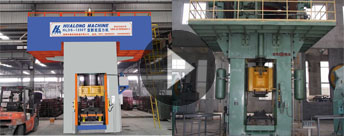
Precision Pressure Control and Dense Structure - Zhengzhou Haloong Servo Screw Press Empowers the Quality Upgrade of Aluminum Magnesium Carbon Bricks
Author: haloong Time: 2026-03-10 15:38:53
Aluminum magnesium carbon bricks are made from high alumina bauxite, fused magnesia, and graphite as core raw materials, combined with binders and formed. The raw material properties and forming process of these bricks have extremely strong particularity - graphite is light in density, fused magnesia is heavy, and high alumina bauxite is hard. The proportion of the three raw materials varies greatly, and the particle size distribution is complex. During the forming process, problems such as raw material stratification, uneven density, and incomplete exhaust are prone to occur. With the global steel and non-ferrous metal industries transforming towards high-end and green development, the quality requirements for aluminum magnesium carbon bricks are becoming increasingly strict. High density, no stratification, low porosity, and strong wear resistance have become the hard standards for the qualified production of aluminum magnesium carbon bricks. However, the shortcomings of traditional forming equipment are becoming increasingly prominent, which has become a key bottleneck restricting the quality improvement and efficiency enhancement of aluminum magnesium carbon brick enterprises. The core pain points are concentrated in three aspects.
First, the pressure control is rough, and the risk of raw material stratification is prominent. Traditional friction presses and ordinary hydraulic presses cannot achieve digital precision pressure control. The pressure intensity and speed cannot be flexibly adjusted according to the raw material ratio and particle size distribution of aluminum magnesium carbon bricks, easily leading to pressure deviations such as "heavier on top and lighter on bottom" and "tighter on the sides and looser in the center". Due to the significant density difference between graphite and fused magnesia, the uneven pressure of traditional equipment will cause graphite particles to float and aggregate, and magnesia particles to sink and accumulate, resulting in obvious stratification. During subsequent drying and sintering, layer cracking and peeling are prone to occur, significantly reducing the steel water erosion resistance and structural stability of aluminum magnesium carbon bricks. Data shows that the stratification defect rate of aluminum magnesium carbon bricks produced by traditional equipment is as high as over 8%, seriously affecting the product qualification rate and market competitiveness.
Second, the force transmission is uneven, and the density of the green body is insufficient. The forming of aluminum magnesium carbon bricks requires the three raw material particles to be closely combined and the internal pores to be expelled, which has extremely high requirements for the uniformity of pressure transmission. The transmission structure of traditional equipment is complex, and components such as gears and clutches have energy losses. The pressure cannot be uniformly transmitted to all parts of the green body, resulting in significant differences in the density of the surface and inner layers, as well as the center and edges of the green body, forming "false density". Under high-temperature service conditions, the internal pores of such green bodies will rapidly expand, easily causing cracks and damage, shortening the service life of aluminum magnesium carbon bricks and increasing the downtime and replacement costs for terminal smelting enterprises.
Third, the process adaptability is insufficient, and exhaust and density cannot be balanced. During the semi-dry forming process of aluminum magnesium carbon bricks, if the internal air of the raw materials cannot be fully expelled, it will form bubbles in the green body, which will burst during drying and form voids, leading to stratification and cracking. At the same time, if the pressure is applied too quickly, it will cause uneven distribution of the binder, affecting the strength of the green body; if the pressure is applied too slowly, it will cause the raw material particles to settle and stratify. Traditional equipment mostly adopts a single pressure mode and cannot achieve precise matching of "exhaust and density", making it difficult to balance the exhaust effect and the density of the green body, further exacerbating the forming risks. Meanwhile, with increasingly strict global environmental protection requirements and rising labor costs, aluminum magnesium carbon brick enterprises urgently need efficient, intelligent, and stable forming equipment to solve the forming pain points and achieve multiple goals of quality improvement, cost reduction, and efficiency enhancement.
Compared with traditional forming equipment, the servo screw press, with its core advantages of digital precision pressure control, flexible process adaptability, and efficient energy transmission, is the best choice to solve the forming problems of aluminum magnesium carbon bricks. It can not only completely solve the shortcomings of traditional equipment such as uneven pressure, incomplete exhaust, and raw material stratification, but also achieve uniform distribution of the three raw material particles and full density of the green body, perfectly meeting the core forming requirements of aluminum magnesium carbon bricks and helping aluminum magnesium carbon brick enterprises break through the quality bottleneck. Relying on 45 years of experience in refractory forming equipment research and manufacturing, Zhengzhou Haloong has deeply integrated the third-generation permanent magnet synchronous servo direct drive technology with the semi-dry forming process of aluminum-magnesium-carbon bricks. By combining the characteristics of aluminum-magnesium-carbon brick raw materials and production pain points, Haloong has developed a dedicated servo screw press for aluminum-magnesium-carbon bricks, which meets the global high-end equipment standards. With "uniform force control, thorough exhaust, and precise matching" as its core, it addresses issues such as insufficient density, ensuring the quality of aluminum-magnesium-carbon brick forming and becoming the preferred equipment for domestic and foreign aluminum-magnesium-carbon brick enterprises.
The servo screw press adopts a direct drive design with permanent magnet synchronous servo motors, eliminating traditional clutch and gear transmission structures. The transmission chain is short and energy loss is low. It is equipped with Haloong's independently developed intelligent pressure control system, which can precisely preset the pressing energy, speed, and frequency through digital programs. The energy repetition control accuracy is ≤±1%, far exceeding the industry average, achieving "uniform force pressing throughout the area" and precisely matching the forming requirements of the three raw materials of aluminum-magnesium-carbon bricks. In response to the significant density differences of aluminum-magnesium-carbon brick raw materials, it intelligently matches a three-stage forming process: "light pressure exhaust - medium pressure uniform material distribution - heavy pressure densification". During the light pressure stage, it slowly applies pressure to thoroughly expel the internal air of the raw materials, avoiding the formation of bubbles and cracking. During the medium pressure stage, it uniformly applies pressure to promote the uniform distribution of graphite, fused magnesia, and high alumina bauxite particles, eliminating density differences that cause settlement and layering. During the heavy pressure stage, it precisely controls the pressure to achieve a tight combination of the three raw material particles, enhancing the density and interlayer bonding strength of the green body, ensuring uniform density from the surface to the core and from the center to the edge, completely eliminating layering and delamination defects. The product qualification rate of aluminum-magnesium-carbon bricks is stable at over 99%, and the density is increased by more than 15% compared to traditional equipment.
It breaks through the structural bottom dead center limitation of traditional equipment and adopts a step-by-step forging mode. According to the different specifications (standard bricks, special-shaped bricks, large lining bricks) and different raw material ratios of aluminum-magnesium-carbon bricks, it can flexibly adjust the stroke of the slider and the pressing angle, without worrying about uneven pressing caused by raw material size deviations or property changes. Whether it is large aluminum-magnesium-carbon bricks for converters, special-shaped aluminum-magnesium-carbon bricks for ladles, or high-density aluminum-magnesium-carbon bricks for refining furnaces, it can achieve precise uniform force pressing, ensuring the uniform distribution of the three raw material particles and a dense green body without gaps, eliminating cracks and delamination caused by local over-pressing or under-pressing. At the same time, the equipment can flexibly adapt to aluminum-magnesium-carbon brick green bodies with different compression ratios, without frequent adjustments to the equipment structure, significantly improving the forming adaptability and helping enterprises expand the product matrix of aluminum-magnesium-carbon bricks.
It adopts a fully enclosed static pressure screw, nut, and bearing transmission, forming a stable oil film during operation for protection. Combined with an automatic forced lubrication system, it effectively reduces the wear of transmission components, ensuring continuous and stable pressure transmission without energy loss or pressure decay, perfectly meeting the strict requirements for pressure stability in the forming of aluminum-magnesium-carbon bricks. Compared to the rigid transmission of traditional equipment, the static pressure transmission of Haloong's servo screw press can achieve flexible pressure transmission, avoiding the formation of cracks in the green body due to local stress concentration. At the same time, the transmission is stable, and the equipment operation vibration is small, further ensuring the uniformity and consistency of the aluminum-magnesium-carbon brick green body forming, eliminating forming risks from the process level. In addition, the transmission chain is short, the structure is simple, it is easy to maintain and repair, and the later operation and maintenance costs are extremely low, meeting the large-scale production needs of aluminum-magnesium-carbon brick enterprises.
Relying on Haloong's 45 years of refractory forming process experience, the servo screw press is equipped with a dedicated aluminum-magnesium-carbon brick forming parameter database, covering the forming parameters of different ratios and specifications of aluminum-magnesium-carbon bricks. It can intelligently customize forming programs and pressing parameters based on the characteristics of raw materials from different origins and different ratios of graphite, fused magnesia, and high alumina bauxite, eliminating the need for frequent manual adjustments and reducing the impact of human factors on forming accuracy. In response to the significant density differences between graphite and magnesia, it can precisely adjust the pressing speed and force to avoid raw material layering and aggregation. Equipped with a rapid mold changing system, the mold replacement is convenient and efficient, significantly reducing the production preparation time. It can not only meet the production needs of small-batch customized aluminum-magnesium-carbon bricks but also adapt to large-scale mass production requirements, ensuring that each batch of aluminum-magnesium-carbon bricks can be formed without delamination and with high quality.
It is equipped with the intelligent production management system independently developed by Zhengzhou Haloong, featuring standardized industrial communication interfaces. It can be seamlessly integrated with the automatic feeding system, raw material proportioning system, and green body inspection equipment for aluminum-magnesium-carbon bricks, building an intelligent production line for the entire process of aluminum-magnesium-carbon brick forming, achieving unmanned control from "raw material entry - proportioning - pressing - inspection - storage". The system collects real-time data such as forming pressure and speed, allowing for dynamic adjustment of the pressing process, timely correction of pressure deviations, ensuring uniform pressure application, and guaranteeing the density and uniformity of the aluminum-magnesium-carbon brick green bodies. It also supports remote monitoring and parameter adjustment, facilitating domestic and international customers to manage production remotely, promptly identify forming risks, and further ensure product quality. Additionally, the equipment adopts a "start on demand, sleep for energy saving" mode, saving over 55% energy compared to traditional friction presses, helping aluminum-magnesium-carbon brick enterprises achieve multiple goals of "energy conservation, cost reduction, and high quality", in line with the global trend of green production.
The quality of aluminum-magnesium-carbon bricks directly affects the production safety and efficiency of the steel and non-ferrous metal smelting industries, and the forming equipment is the core guarantee of quality. Zhengzhou Haloong has been deeply engaged in the field of refractory material forming equipment for 45 years, adhering to the concept of "starting from design, excelling in process, focusing on processing, and achieving in assembly". Relying on technological progress, with strict process regulations, complete inspection methods, and a complete management system, it continuously promotes technological innovation in servo screw presses, focuses on the core pain points of aluminum-magnesium-carbon brick forming, and creates exclusive intelligent solutions.


