



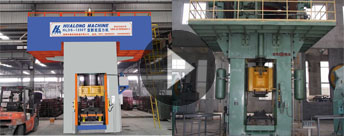
Low Creep Resistance and Toughness Assurance - Specialized Servo Screw Press Solution for Low Creep Refractory Bricks
Author: haloong Time: 2026-05-12 14:54:32
The core competitiveness of low creep refractory bricks lies in their comprehensive characteristics of "high-temperature creep resistance and toughness", which is entirely dependent on precise control during the forming stage. The forming process must meet six key requirements: uniform density, dense structure, no cracks, intact corners, precise dimensions, and uniform dispersion of modifiers. It is necessary to ensure uniform density throughout the green body to maintain a stable volume density of the finished product, with an open porosity controlled within a reasonable range (typically ≤15%), laying a solid foundation for subsequent high-temperature sintering and enhancing the low creep performance and thermal shock resistance of the finished product. At the same time, the pressing speed and holding time must be precisely controlled to accommodate the high purity of the raw materials, fine particle size distribution, and difficult exhaust of low creep refractory bricks, avoiding residual pores within the green body that could lead to creep deformation and structural spalling during high-temperature service. Additionally, the forming pressure requirements for different specifications and applications of low creep refractory bricks must be precisely matched to prevent cracking due to over-pressing or porosity due to under-pressing, while ensuring uniform dispersion of modifiers to fully leverage their ability to reduce creep rate and enhance structural stability. Currently, the technical shortcomings of traditional forming equipment have led to widespread issues in the production of low creep refractory bricks, such as uneven green body density, excessive porosity, corner damage, large dimensional deviations, uneven dispersion of modifiers, and low product qualification rates, severely restricting the industrialization of high-end low creep refractory bricks. Zhengzhou Haloong, relying on the third-generation permanent magnet synchronous servo direct drive core technology, has optimized and upgraded the HLDS series of CNC servo screw presses, specifically addressing the forming challenges of low creep refractory bricks and creating dedicated forming equipment. With the core advantages of precise pressure control, stable pressure transmission, and intelligent adaptability, it has established a benchmark for the quality of high-end low creep refractory bricks.
Compared to ordinary refractory bricks, the forming difficulty of low creep refractory bricks has significantly increased due to their high raw material purity, addition of special modifiers, and strict forming process. The mix for low creep refractory bricks is centered around high-purity bauxite and corundum, combined with dedicated modifiers and binders. The raw material particles are hard, have a fine particle size distribution, and require high uniformity in composition. Moreover, the mix has poor fluidity and is difficult to exhaust during the forming process. During forming, the application of pressure, speed, and rhythm must be precisely controlled to achieve densification of the green body while avoiding cracking and corner damage, and ensuring uniform dispersion of modifiers to meet the process requirements of different specifications of products. Additionally, low creep refractory bricks come in various specifications, ranging from furnace lining bricks and hot blast stove bricks in the metallurgical industry to rotary kiln lining bricks in the cement industry and electric furnace bricks in the power industry. The forming pressure, pressing speed, and holding time for different types of products vary significantly, placing extremely high demands on the process adaptability of the equipment.
Zhengzhou Haloong has deeply studied the raw material characteristics, forming process logic, and industry upgrade needs of low creep refractory bricks. By integrating the core technologies of permanent magnet synchronous servo motor direct drive, static pressure flexible pressure transmission, and intelligent numerical control system, it has specifically optimized the HLDS series of servo screw presses, comprehensively upgrading the equipment's precision, stability, and adaptability. These advantages precisely match the four key forming requirements of low creep refractory bricks: uniformity, density, crack resistance, and uniform dispersion of modifiers, making it the preferred equipment for mass production of high-quality low creep refractory bricks. It helps refractory material enterprises create high-quality products suitable for high-temperature, high-stress, and high-corrosion working conditions, seizing the opportunity in the high-end market.
Equipped with a core permanent magnet synchronous servo motor direct drive system, it completely eliminates the inefficient transmission structures such as traditional friction discs and clutches, with an extremely short transmission chain and zero energy loss in pressure transmission, ensuring stable and controllable pressure output throughout the process. The equipment is equipped with a low creep refractory brick dedicated numerical control pressure module independently developed by Haloong, which can digitally and precisely set the striking energy, pressurization speed, stepwise pressurization times, and pressure holding duration. The energy repetition control accuracy is ≤±1%, ensuring that the pressure for each molding is highly consistent, completely eliminating the quality deviation caused by manual operation and mechanical fluctuations. In response to the characteristics of low creep refractory bricks, such as high raw material purity, difficulty in exhaust of the mixed material, and high requirements for the dispersion of modifiers, a customized "light pressure exhaust - slow pressure densification - long-term pressure holding" stepwise pressurization process is adopted. First, light pressure is applied to the loose raw materials to slowly expel the residual air inside, then stepwise steady pressure is applied to compact the material layer by layer (with the pressure gradually increasing to avoid impact), and finally long-term pressure holding is used for shaping. This ensures that all parts of the green body, including the center, edges, and corners, are uniformly stressed, with density fluctuations controlled within a very small range. It also guarantees a dense green body structure with a reasonable open porosity rate, while promoting the uniform dispersion of modifiers to fully exert their effects in reducing creep rate and enhancing structural stability, providing a solid foundation for subsequent high-temperature sintering and increasing the finished product qualification rate to over 99%.
The equipment adopts a fully enclosed static pressure screw, nut, and dedicated heavy-duty bearing transmission structure. During operation, a stable high-pressure oil film is formed for protection, achieving flexible and uniform pressure application and slow pressurization, completely avoiding the severe impact force and stress concentration problems caused by traditional rigid pressurization. The pressurization process is smooth and gentle, with uniform and soft pressure transmission. This not only fully expels the internal pores of the green body and ensures its density but also completely eliminates defects such as porosity, delamination, and micro-cracks. At the same time, it avoids the cracking and edge damage of the green body caused by rigid impact, significantly reducing the waste of high-cost raw materials. It also effectively extends the service life of the mold, reduces material costs, and improves the production efficiency of the enterprise, solving the core pain point of traditional equipment, which is "high cracking rate and high scrap rate".
Breaking through the structural limitation of the fixed bottom dead center of traditional equipment, a step-by-step forging molding mode is adopted. According to the material, size, structural complexity (irregular structural parts, lining bricks, furnace wall bricks), density requirements, and raw material ratio (different particle size gradation, modifier addition ratio) of low creep refractory bricks, the stroke of the slider, pressurization depth, and pressurization force can be flexibly adjusted to precisely match the molding requirements of various low creep refractory bricks, covering the full range of production scenarios for high-end low creep refractory bricks. There is no need to worry about the problems of uneven pressurization or green body cracking caused by deviations in raw material filling volume, particle size gradation differences, and changes in the fluidity of the mixed material. Combined with a rapid mold changing system, mold changing is convenient and efficient, perfectly adapting to the flexible mode of multi-variety and batch production, meeting the batch supply needs of high-end fields such as metallurgy, cement, and power, and accommodating the molding requirements of both ordinary lining bricks and high-strength low creep refractory bricks. It can achieve uniform density control for deep cavity and irregular low creep refractory parts.
The equipment is equipped with a dedicated low creep refractory brick molding parameter database, integrating the optimal molding process parameters for various specifications, different raw material ratios, different particle size gradations, different modifier addition ratios, and different density requirements of low creep refractory bricks. It covers the molding parameters of common products such as standard low creep lining bricks, irregular low creep bricks, and high-strength low creep refractory bricks. Operators can retrieve them with one click, eliminating the need for repeated debugging and exploration, significantly reducing the interference of human factors on product quality. All molding parameters can be permanently saved and reused in batches, ensuring that the density, compactness, and dimensional accuracy of each batch and each product are highly consistent, with no cracking or damage to the green body and uniform dispersion of modifiers, easily meeting the strict quality requirements of high-end fields at home and abroad, and helping enterprises smoothly open up the overseas high-end low creep refractory brick market. Compared with traditional friction presses, the Haloong servo screw press adopts an intelligent mode of on-demand start-stop and sleep energy-saving, with the servo motor only operating during the pressing process and having zero energy consumption in standby mode. The comprehensive energy-saving rate is as high as over 55%, and in some working conditions, it can reach up to 60%, significantly reducing the electricity cost for the production of low creep refractory bricks and meeting the green and low-carbon development needs of the refractory materials industry. Meanwhile, the static pressure transmission structure has minimal wear, and it is equipped with a fully automatic forced lubrication system and an oil shortage alarm device, achieving maintenance-free operation. The equipment has a low failure rate and a service life far exceeding that of traditional equipment, reducing the later operation and maintenance costs by more than 40%. It comprehensively compresses production, operation and maintenance, and material costs, helping enterprises achieve a green, low-carbon, and highly efficient production model, solving the pain points of traditional forming equipment such as "high energy consumption and complex operation and maintenance". Just like the energy-saving and efficiency-increasing results achieved by Jiaozuo Xincheng Group after the transformation, it helps enterprises reduce the overall production cost.
The equipment is equipped with standardized industrial communication interfaces, which can be seamlessly connected with automatic and precise feeding machines, closed-loop distribution machines, intelligent demolding machines, non-destructive testing equipment for green bodies, and constant-temperature conveying lines, building an automatic and intelligent forming production line for low creep refractory bricks. It realizes unmanned control throughout the entire process from distribution, pressing, pressure holding, demolding to green body transfer and inspection, minimizing human intervention. This not only avoids damage to the green body caused by manual operation and reduces the risk of green body cracking, but also ensures the forming accuracy and production efficiency, while ensuring the uniform dispersion of modifiers. It also supports remote monitoring, parameter adjustment, fault warning, and production data traceability functions, facilitating domestic and foreign customers to remotely and in real-time control the production progress and product quality. It fully meets the global trend of intelligent, digital, and green transformation in the refractory materials industry, helping enterprises build high-end low creep refractory brick intelligent production bases and enhance large-scale mass production capabilities.
As a leading enterprise in the domestic electric servo screw press field, Zhengzhou Haloong Machinery Co., Ltd. has been focusing on the technological innovation of refractory material forming equipment for 45 years, deeply exploring the pain points in the forming process of high-end refractory materials such as low creep refractory bricks, and insisting on empowering industrial upgrading with customized technology. The Haloong HLDS series CNC servo screw press covers the full tonnage range from 200T to 1600T. According to the customer's requirements for the material, specifications, capacity, density, and raw material ratio (particle size distribution, modifier addition ratio) of low creep refractory bricks, it provides one-to-one customized forming solutions, fully meeting the mass production needs of various low creep refractory bricks, and adapting to the supply of refractory materials in different high-temperature, high-stress, and high-corrosion fields. It solves the problems of low efficiency, uneven density, and uneven dispersion of modifiers in traditional vibration forming, and can achieve precise forming of low creep refractory bricks with micro-porous structure, with the porosity deviation controlled within ±5%.


