



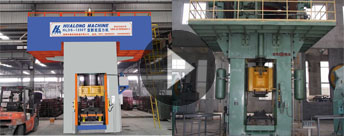
Locomotive Safety Upheld by Forging Presses
Author: haloong Time: 2025-12-03 09:00:33
In the realm of rail transportation, locomotive safety stands as an uncompromisable cornerstone, where every component’s reliability directly bears on the lives of passengers and the integrity of cargo. Among the numerous manufacturing technologies that underpin this safety, forging presses emerge as silent guardians, shaping the critical load-bearing parts that enable locomotives to operate securely under extreme conditions. From couplers that link carriages with unwavering strength to connecting rods that translate engine power smoothly, these forged components owe their exceptional performance to the advanced capabilities of modern forging presses.
The core advantage of forging presses lies in their ability to enhance material properties through precise and controlled processing. Unlike traditional manufacturing methods that may leave internal defects, these presses apply sustained and uniform pressure to metal workpieces, ensuring that the material’s grain structure becomes dense and continuous throughout the entire cross-section. This structural optimization significantly boosts the components’ mechanical performance—mechanical strength increases by over 20% compared to conventional processes, while fatigue resistance and impact toughness are also substantially improved. For locomotives that operate for thousands of kilometers under heavy loads, this means a drastic reduction in the risk of component failure, even in harsh environments such as high-speed operation or frequent braking.
Intelligent technology has further elevated the role of forging presses in ensuring locomotive safety. Modern presses are equipped with advanced servo drive systems and multi-channel sensing technology, enabling millisecond-level precise control of forging energy and real-time monitoring of temperature fields and deformation resistance. During the production of complex parts like bogie components or gear assemblies, the press can automatically adjust process parameters to maintain the integrity of the metal’s flow lines and ensure uniform grain size, which is crucial for consistent component quality. Additionally, intelligent temperature control systems keep the blank within the recrystallization temperature range, avoiding high-temperature oxidation while preserving material plasticity, thus enhancing both surface quality and dimensional accuracy—with precision often stabilized within ±0.1mm, meeting the rigorous standards of locomotive manufacturing.
Beyond performance enhancement, forging presses also contribute to safety through efficiency and sustainability. Their near-net shaping capability minimizes material waste, with material utilization rates reaching over 95% for standard parts like bolts and pins, reducing the need for excessive secondary processing that could introduce structural flaws. Energy-saving features, such as optimized hydraulic systems and process-adaptive functions, cut energy consumption by more than 25% compared to traditional forging methods, while also creating a cleaner production environment. Moreover, the high rigidity of press structures and mold buffering systems ensure stable operation even under ten-thousand-ton-level forging forces, with equipment availability rates remaining above 95% through comprehensive lifecycle support services.
As rail transportation evolves toward higher speeds and heavier loads, the demands on locomotive components continue to rise. Forging presses, with their combination of precision, strength, and intelligence, remain at the forefront of meeting these challenges. They transform raw metal into robust, reliable parts that form the backbone of locomotive safety, ensuring that every journey is supported by components forged to withstand the test of time and pressure. In the quiet hum of a forging press, we find the unspoken promise of rail safety—one precisely shaped component at a time.


