



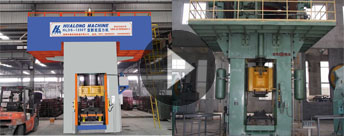
Gear Smart Manufacturing’s New Engine: How Servo Screw Presses Are Redefining Precision Machining Landscape
Author: haloong Time: 2025-12-09 09:38:04
In the intricate ecosystem of gear manufacturing, where even a micrometer-level deviation can compromise the performance of an entire mechanical system, the pursuit of higher precision, faster production, and greater reliability has never ceased. For decades, traditional forging presses—whether hydraulic, mechanical, or pneumatic—have underpinned gear production, but their inherent limitations (fixed motion trajectories, coarse force control, and low energy efficiency) have gradually become bottlenecks as industries like electric vehicles (EVs), aerospace, and industrial robotics demand gears with ultra-tight tolerances, complex geometries, and enhanced mechanical properties. It is in this context that the servo screw press has emerged as a transformative catalyst, reengineering the fundamentals of precision machining and reshaping the competitive landscape of gear manufacturing.
The core breakthrough of servo screw presses lies in their digitally controlled, closed-loop operation system, which decouples the press’s motion from rigid mechanical constraints. Unlike conventional presses that rely on cam mechanisms or hydraulic valves to dictate stroke and force, servo screw presses leverage high-torque servo motors connected directly to the screw drive. This design allows for real-time adjustment of every parameter: stroke length can be calibrated to 0.01mm increments, pressing speed can shift from 0.1m/s to 1.5m/s mid-cycle, and holding pressure can be maintained within a 1kN tolerance for extended durations. For gear production, this granular control is a game-changer. When forging spur gears for EV drivetrains—components that require surface roughness below Ra 0.8μm and tooth profile deviation under 0.02mm—the press can slow to a near-static speed during the final forming stage, allowing metal to flow uniformly into the die cavity without creating micro-cracks or residual stress. By contrast, traditional mechanical presses, limited by their fixed crank motion, often leave 5%–8% of gears with substandard tooth geometry, requiring costly post-machining.
Beyond precision, servo screw presses redefine efficiency through adaptive process optimization. Modern models integrate AI-driven sensors that monitor factors like workpiece temperature, die wear, and material flow resistance in real time. For example, when processing high-strength alloy steels (common in aerospace gear shafts), the system automatically extends the holding time if the material’s plastic deformation rate falls below a threshold, ensuring full die filling without overloading the press. This adaptability cuts scrap rates by 20%–25% compared to static traditional processes. Additionally, their servo-driven architecture reduces energy consumption by 40%–50%: unlike hydraulic presses that run continuously at full power, servo screw presses only draw electricity during active motion, aligning with global sustainability mandates for manufacturing.
The impact of servo screw presses extends further into scalability and integration with smart factories. Their modular design allows seamless connection to robotic material handlers, 3D scanning inspection systems, and MES (Manufacturing Execution Systems) platforms. In a fully automated gear production line, the press can receive real-time design updates from CAD software, adjust its parameters within seconds, and transmit process data (e.g., force-stroke curves, cycle times) to cloud-based analytics tools for predictive maintenance. For complex gear types—such as helical bevel gears for aircraft landing gear—this integration enables multi-stage forging in a single machine: the press first pre-forms the blank with a low-speed, high-force stroke, then switches to a high-speed, low-force cycle to finish the tooth profile, eliminating the need for intermediate machining steps. This not only cuts production lead times by 30% but also reduces the risk of dimensional errors caused by multiple workpiece transfers.
As the global gear market is projected to grow to $150 billion by 2030 (driven by EV and robotics demand), the role of servo screw presses is evolving from “advanced equipment” to “core infrastructure” for smart manufacturing. Manufacturers that adopt this technology are not only improving component quality—they are also building flexible production lines that can switch between gear types (e.g., from automotive transmission gears to robotic arm gears) in under an hour, a feat impossible with traditional presses. In essence, servo screw presses are not just redefining precision machining; they are enabling a new paradigm of gear manufacturing—one that is digital, efficient, and resilient enough to meet the demands of the next industrial era.


