



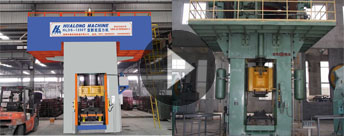
The Core Equipment Shaping High-Performance Golf Club Heads: Precision Forging Presses
Author: haloong Time: 2025-12-19 10:14:54
In the world of golf, where every swing and every shot can determine the outcome of a game, the performance of golf clubs is paramount. Among the various components of a golf club, the club head stands out as a critical factor influencing hitting accuracy, distance, and feel. Behind the creation of high-performance golf club heads lies a piece of industrial equipment that plays an irreplaceable role: precision forging presses. These machines are the unsung heroes in the manufacturing process, translating raw materials into meticulously crafted club heads that meet the rigorous demands of professional golfers and enthusiasts alike.
The Role of Precision Forging Presses in Golf Club Head Manufacturing
Precision forging presses revolutionize the production of golf club heads by enabling near-net-shape forming. Unlike traditional manufacturing methods that involve extensive machining and manual polishing, these presses use high-pressure force to shape metal blanks—such as carbon steel, nickel-chromium-molybdenum steel, and titanium alloy—into forms that are extremely close to the final club head design. This process not only significantly reduces material waste and production time but also ensures exceptional consistency across batches. For golfers, consistency means that each club in a set performs uniformly, allowing them to develop a reliable swing rhythm and improve their overall game.
Technical Advantages: Enhancing Club Head Performance
One of the key technical advantages of precision forging presses is their ability to create club heads with high density and continuous metal fibers. During the forging process, the pressure applied by the machine refines the grain structure of the metal, closes internal pores, and forms a continuous flow of metal fibers that run through critical areas such as the club face and neck. This structural integrity significantly enhances the club head's impact resistance and rebound performance. When a golfer strikes the ball, a forged club head delivers a more solid feel and a crisper sound, providing valuable feedback that helps golfers adjust their swing in real time.
Additionally, precision forging presses offer exceptional control over the shape and weight of the club head. They can precisely regulate critical parameters such as club face thickness, center of gravity, sole angle, and groove dimensions. For high-performance golf clubs, even minor deviations in these parameters can have a significant impact on performance. With the precision of forging presses, manufacturers can ensure that each club head meets strict design specifications, resulting in consistent swing and ball-striking repeatability. For example, the weight deviation of high-end forged iron heads can be controlled within 5-6 grams, far superior to that of club heads made by other processes.
Adaptability to Diverse Golf Club Types
Precision forging presses are highly adaptable to the production of various types of golf club heads, from irons and wedges to drivers and fairway woods. For professional and high-end irons (such as blade and semi-blade irons), multi-stage forging processes using precision presses create one-piece club faces and necks, ensuring optimal performance and feel. For titanium alloy drivers and fairway woods, high-tonnage precision forging presses (often hundreds to thousands of tons) are used to achieve thin-walled, high-strength structures with a low center of gravity—design features that maximize ball speed and distance. Wedges, which require precise groove dimensions for consistent spin and ball control, also benefit greatly from the precision of forging presses, as they can replicate complex groove patterns with high accuracy, laying a solid foundation for golfers to achieve stable shot landing points.


