



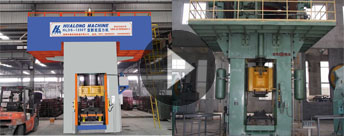
Closed Die Forged Steel Components & Precision Forging Presses: The Core Synergy in High-End Forging
Author: haloong Time: 2026-01-07 09:21:49
In the realm of high-end manufacturing, closed die forged steel components have become indispensable core parts in industries such as automotive, aerospace, and heavy machinery, owing to their superior mechanical properties, high dimensional accuracy, and excellent structural integrity. However, the realization of these high-performance forging parts is not possible without the strong support of precision forging presses. The relationship between closed die forged steel components and precision forging presses is a mutually driving and highly compatible synergy, which constitutes the technical core of modern high-end forging industry.
The closed die forging process, also known as flashless forging, is characterized by confining the metal billet in a fully enclosed die cavity and applying high pressure to induce plastic deformation, thereby making the billet fully fill the cavity to form the desired shape. This process has extremely strict requirements on the forging equipment: it not only needs sufficient forging force to overcome the internal resistance of the steel billet but also requires precise control of the forming process to avoid defects such as uneven deformation and die misalignment. Precision forging presses perfectly meet these requirements with their advanced structural design and intelligent control system. The rigid machine frame ensures that the equipment does not produce excessive deformation under high pressure, effectively preventing die offset and ensuring the dimensional accuracy of the forged parts. At the same time, the servo-driven system of the precision forging press can realize stepless speed regulation and precise pressure control, making the metal billet flow uniformly in the die cavity, reducing internal defects such as porosity and cracks, and improving the density and mechanical properties of the forged parts.
The synergy between closed die forged steel components and precision forging presses is also reflected in the improvement of production efficiency and quality consistency. High-end industries have increasingly strict requirements on the dimensional tolerance and surface quality of forged steel components, and the goal is to achieve near-net shape forming to minimize subsequent machining allowances. The stroke accuracy of precision forging presses can be controlled within a very small range, and the downstroke correction technology can effectively compensate for the accuracy deviation caused by temperature rise, ensuring that the dimensional deviation of each forged part is within the allowable range. In addition, precision forging presses have strong adaptability to automation, and can be seamlessly connected with robots, automatic feeding and unloading devices to form a continuous production line. This not only greatly improves production efficiency—for example, the production speed can be increased by more than 60% compared with traditional equipment—but also reduces human errors, ensuring the consistency of product quality batch by batch.
The continuous innovation of precision forging press technology is also promoting the upgrading and application expansion of closed die forged steel components. With the development of technologies such as hydraulic servo control and intelligent process monitoring, modern precision forging presses can handle more complex and high-performance steel materials, and realize the forming of more intricate structural parts. For example, in the automotive industry, precision forging presses can produce crankshafts, connecting rods, and transmission gears with higher strength and fatigue resistance; in the aerospace field, they can forge high-stress components such as turbine disks and landing gear parts that meet strict safety standards. These advancements not only enhance the performance of closed die forged steel components but also expand their application boundaries in high-end fields.
In conclusion, the core synergy between closed die forged steel components and precision forging presses is the key to promoting the high-quality development of the forging industry. Precision forging presses provide reliable equipment guarantee for the high-precision and high-performance forming of closed die forged steel components, while the increasing demand for high-end closed die forged steel components drives the technological innovation and upgrading of precision forging presses. In the future, with the continuous integration of intelligent technologies such as AI and 3D simulation into the forging process, this synergy will be further strengthened, bringing more possibilities for the development of the high-end manufacturing industry.


