



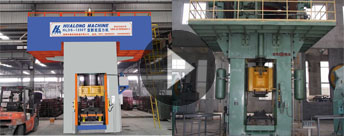
Precision Shaping · Adaptable to Special Shapes – Servo Screw Presses Solve the Forming Challenges of Special-Shaped Refractory Bricks
Author: haloong Time: 2026-02-07 14:18:28
With the global transformation of high-temperature industries toward green, large-scale and high-end development, the demand for special-shaped refractory bricks in key parts such as coke oven heads, converter linings, and transition zones of cement rotary kilns continues to rise. Especially in high-end overseas markets including Europe, North America and Southeast Asia, stricter standards have been imposed on the dimensional accuracy, density uniformity and service stability of special-shaped bricks.However, in the current production of special-shaped refractory bricks, traditional forming equipment generally suffers from numerous pain points that severely restrict industrial upgrading:Traditional frictionpresses rely on mechanical transmission with unstable energy release, and cannot precisely control pressing force and speed. For complex parts of special-shaped bricks such as curved surfaces and corners, local overpressure easily causes edge chipping, or local underpressure leads to insufficient compactness. Subsequent sintering tends to result in defects such as cracks and spalling, making the products unable to resist extreme corrosion in high-temperature working conditions.Ordinary hydraulic presses feature slow response and insufficient transmission rigidity, failing to meet the special forming requirements of "zoned compaction and gradient exhaust" for special-shaped bricks. In addition, uneven force transmission leads to obviousdensity differences in different wall thickness positions, affecting structural stability and making it difficult to satisfy the long-term stable service demand of large high-temperature equipment.Some forming equipment has a low degree of automation and relies on manual parameter adjustment and auxiliary demolding. This not only keeps labor costs high, but also easily causes excessive dimensional deviation in the same batch due to human errors, failing to meet standardized assembly requirements. Meanwhile, manual demolding often leads to corner damage, drastically lowering product qualification rate.Furthermore, traditional equipment has poor adaptability. After replacing molds for special-shaped bricks, parameter debugging is cumbersome and time-consuming, unable to quickly respond to customized production of multi-specification, small-batch special-shaped bricks, and incompatible with the flexible production transformation of refractory enterprises.
The core forming difficulties of special-shaped bricks lie in precise control of irregular structures and uniform density across the entire part: it is necessary to ensure forming accuracy of complex curved surfaces and special-shaped corners, while solving problems of poor exhaust and uneven material distribution during forming. This requires forming equipment to possess precise pressure control, flexible process adaptability and stable operation performance.Against this backdrop, relying on 45 years of experience in equipment R&D and manufacturing, combined with the raw material characteristics (high hardness, low fluidity) and forming process features of special-shaped refractory bricks, Zhengzhou Haloong has carried out targeted optimization and upgrading of servo screw presses, launching exclusive equipment suitable for forming various special-shaped refractory bricks (curved bricks, wedge bricks, groove bricks, irregular special-shaped parts, etc.). With core advantages of precise pressure control, intelligent adaptation, stability and high efficiency, it has become the core support for refractory enterprises to break through production bottlenecks of special-shaped bricks and seize high-end markets. It demonstrates the technical strength of "Haloong" as the leading brand of electric screw presses, helping enterprises expand their high-end special-shaped brick product portfolio and enhance global market competitiveness.
As a national patented product, Zhengzhou Haloong servo screw presses adopt the third-generation permanent magnet synchronous servo direct drive technology, benchmarked against world-class high-end refractory forming equipment. Specially optimized for the forming difficulties of special-shaped refractory bricks, they are perfectly suitable for mass and customized production of special-shaped bricks of different materials such as high-alumina, magnesia and carbon-based. They can meet both large-scale production of conventional special-shaped bricks and precision forming of high-end special-shaped bricks with complex curved surfaces, thick walls and thin walls. The presses comprehensively solve forming pain points, consolidate product quality foundation, and adapt to the upgrading needs of intelligent manufacturing production lines for special-shaped refractory bricks.
Adopting a permanent magnet synchronous servo direct drive design and eliminating traditional clutch and gear transmission structures, the equipment realizes digital precise control of pressing speed, pressure and stroke, with energy repeat control accuracy ≤ ±2.5%, approaching the level of world’s top servo forming equipment. It can accurately match the special forming requirements of "zoned compaction and gradient exhaust" for special-shaped refractory bricks.Aiming at the characteristics of complex shape, uneven wall thickness and difficult exhaust of special-shaped bricks, the equipment can preset a dedicated forming process of "multi-stage light pressing for exhaust, zoned gradient compaction" through programs, precisely controlling the striking force, speed and stroke of each stage. Targeted pressing is applied to key parts such as curved surfaces, corners and thick walls, fully exhausting air inside the green body and effectively avoiding insufficient compactness caused by material agglomeration. This ensures uniform density across the entire special-shaped brick green body, with density coefficient of variation controlled below 1.0%, effectively preventing defects such as cracks, delamination and spalling after sintering.
Meanwhile, the servo motor features strong overload capacity, allowing a load of twice the nominal pressure, adapting to the compaction demand of high-hardness refractory raw materials while maintaining the bonding stability of binders. It precisely controls pressing force at corner positions, avoiding overpressure chipping and underpressure insufficient filling, greatly improving the forming qualification rate of special-shaped bricks.Breaking through the structural bottom dead center limitation of traditional presses, the equipment adopts a non-fixed bottom dead center design, eliminating the risk of equipment overload and jamming caused by raw material ratio deviation, critical particle size difference or uneven mixing. Its adaptability far exceeds that of traditional forming equipment.
Through digital programs, the equipment can flexibly adjust forming parameters and quickly adapt to forming requirements of refractory special-shaped bricks of different specifications and shapes (curved bricks, wedge bricks, groove bricks, furnace head special-shaped bricks, etc.) and different materials (high-alumina, magnesia, carbon-based, etc.) without complex debugging. It is especially suitable for layered compaction forming of thick-walled and thin-walled special-shaped bricks, ensuring consistent compactness at all positions of the green body, with dimensional accuracy error controlled within ±0.5 mm. This meets the requirements of dimensional standardization and precise assembly for high-end high-temperature equipment at home and abroad.At the same time, the equipment can realize free switching between high and low speeds in a single stroke, fully simulating the precision of manual operation. For complex structures of special-shaped bricks, it flexibly adjusts pressing speed to avoid material displacement caused by high-speed pressing, further improving forming quality and reducing green body defects. It adapts to customized production of multi-specification, small-batch special-shaped bricks, helping refractory enterprises realize flexible production.
The equipment adopts a fully enclosed static pressure screw, nut and bearing transmission structure, forming a stable oil film protection during operation. Coupled with a fully automatic forced lubrication system, it effectively reduces equipment wear, doubling the service life compared with ordinary screw presses. It can stably support large-scale, high-intensity production of special-shaped refractory bricks for a long time – especially suitable for continuous production of intelligent manufacturing projects with an annual output of 50,000 tons and above.Featuring a short transmission chain and simple structure, with no vulnerable parts such as friction discs and gearboxes, it enables convenient later maintenance and extremely low maintenance costs. The equipment failure rate is reduced by more than 60%, ensuring continuous and stable production, minimizing downtime losses and avoiding raw material waste in special-shaped brick production.In addition, the equipment runs smoothly with no vibration at low speed, preventing density deviation and uneven material distribution caused by vibration, further guaranteeing forming accuracy and dimensional consistency of special-shaped bricks. Even under long-term continuous operation, it maintains stable and precise pressure control, ensuring uniform quality of the same batch and meeting the standardization requirements of high-end markets at home and abroad.
Equipped with Zhengzhou Haloong’s independently developed intelligent production management system and standardized industrial communication interfaces, the press can seamlessly link with upstream and downstream equipment including automatic feeding systems, raw material proportioning systems, mold release agent spraying equipment, automatic picking robots and green body inspection equipment. It realizes full-process automatic and digital control for special-shaped refractory brick forming, adapting to the upgrading needs of intelligent manufacturing production lines and benchmarking the intelligent level of the world’s first automatic production line of servo direct-drive CNC screw presses for refractory forming.The equipment can receive real-time data such as upstream raw material ratio and feeding speed, automatically adjusting forming parameters to avoid deviations caused by manual intervention, adapting to production requirements of special-shaped bricks of different materials and shapes.
Targeting the difficulty of demolding special-shaped bricks, the system can precisely control demolding speed and force. Cooperating with automatic picking robots, it achieves seamless connection between demolding and picking, reducing the damage rate of special-shaped brick green bodies to below 0.5% and avoiding corner damage caused by manual demolding.Meanwhile, a built-in high-precision data acquisition module with a sampling frequency up to 100 times per second collects key data during forming in real time, uploading to the central control system to form a full-process quality traceability system. This ensures each batch of special-shaped bricks is traceable and controllable, greatly increasing product qualification rate to over 99%.Furthermore, the system supports remote monitoring and parameter debugging, facilitating off-site production management for domestic and overseas customers. It is simple and easy to operate, with one-button control requiring no skilled operators, helping enterprises achieve “staff reduction and efficiency improvement”.
Relying on the core advantages of servo direct drive technology, the equipment realizes an “on-demand start, hibernation energy saving” mode: the motor runs only during forming operations and enters hibernation during feeding, demolding, mold cleaning and other processes, with no invalid power consumption. It saves more than 60% energy compared with traditional friction presses, with motor efficiency ≥ 95%, greatly reducing energy costs for special-shaped refractory brick enterprises – especially suitable for energy-saving demands in large-scale production, in line with the global trend of green industry and low-carbon production.
At the same time, the slider speed is extremely fast when approaching the bottom dead center, completing forming instantly before refractory raw materials and binders cool down. Short contact time with the mold reduces mold wear, extending mold service life by more than 30% and further compressing overall production costs. For the high cost of special-shaped brick molds, the precise pressure control of the equipment reduces mold loss and indirectly lowers mold investment.
In addition, the equipment operates without transmission noise, greatly improving the workshop working environment, complying with domestic and foreign trends of green production and low-carbon development, and meeting the Emission Standard of Air Pollutants for Refractory Industry (GB 41618-2022) and overseas environmental standards. It helps refractory enterprises transform to green production and enhance global market competitiveness.As core supporting products for high-temperature industrial equipment, the quality of special-shaped refractory bricks directly concerns the safe production, green transformation and efficiency improvement of the global high-temperature industry. The upgrading and iteration of forming equipment is the core driving force promoting the special-shaped refractory brick industry toward high-end, standardized and intelligent development.
At present, the refractory industry is transforming toward “high efficiency, long service life, low carbon and intelligence”. As an important symbol of the high-end development of the refractory industry, the intelligent and precise upgrading of the forming process of special-shaped bricks has become the key to industry development.Compared with conventional refractories, special-shaped bricks feature higher production difficulty and stricter technical thresholds. Their quality gap directly reflects the core competitiveness of refractory enterprises, and the performance of forming equipment is the decisive factor for the quality of special-shaped bricks.


