



Breaking through the bottleneck of low qualified rate of refractory products
Author: haloong Time: 2026-02-10 14:04:03
The refractory industry worldwide is generally confronted with the industry predicament of low qualified rate of refractory products, especially in the production of high-end refractory products, the performance shortcomings of traditional forming equipment have become increasingly prominent, directly leading to high defect rates of refractory products and rising production costs. Research data shows that the qualified rate of refractory products produced by traditional friction presses and ordinary hydraulic presses is mostly maintained below 85%, and for some complex-structured and high-density refractory products, the qualified rate is even less than 70%. This results in a large amount of raw material waste and labor time loss, seriously restricting the profit level and market competitiveness of enterprises.
The core pain point of the low qualified rate of refractory products lies in the fact that traditional forming equipment cannot meet the core requirements of refractory product forming: traditional friction presses rely on mechanical transmission, with unstable energy release, and the pressure and speed cannot be precisely controlled, which easily leads to uneven density of the refractory products and excessive density difference between the top and bottom, resulting in defects such as cracks, delamination, and peeling after sintering; ordinary hydraulic presses have lagging response and insufficient transmission rigidity, and cannot achieve the gradient process of "light pressure exhaust and heavy pressure forming", making it difficult to fully expel the internal pores of the refractory products, easily forming loose defects, and at the same time, uneven force transmission leads to corner cracking and size deviation of the refractory products; some forming equipment has low automation, relying on manual parameter adjustment and auxiliary demolding, and human operation errors easily lead to significant quality differences in the same batch of refractory products, further reducing the qualified rate; in addition, traditional equipment has poor adaptability. After changing the molds of different specifications and materials, the parameter adjustment is cumbersome and time-consuming, and it is easy to have a batch of unqualified refractory products during the adjustment period. At the same time, the equipment has a high failure rate and insufficient operational stability, indirectly affecting the consistency of refractory product forming, and is difficult to meet the standardized and large-scale production requirements of the high-end refractory market at home and abroad.
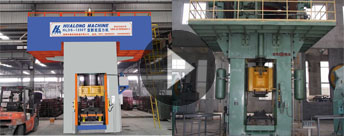
Zhengzhou Haloong HLDS series servo screw press, as a national patent product, adopts the third-generation permanent magnet synchronous servo motor direct drive technology, benchmarking the global high-end refractory forming equipment level, and targeting the core pain points of refractory product forming, it has created a full-process precise forming control system. It can perfectly adapt to the batch forming and customized production of ordinary refractory products, high-end high-density refractory products, special-shaped refractory products, and complex-structured refractory products. With six core advantages, it comprehensively solves the problem of refractory product defects, stably increasing the qualified rate of refractory products to over 99%, significantly reducing raw material waste and production costs, and meeting the intelligent manufacturing production line upgrade needs of refractory enterprises at home and abroad. It empowers the quality upgrade of the refractory industry through equipment innovation.
Adopting a direct drive design with permanent magnet synchronous servo motors, it discards the traditional clutch and gear transmission structure, achieving precise digital control of the pressing speed, pressure, and stroke. The energy repetition control accuracy is ≤±2.5%, approaching the level of international top servo forming equipment, and can precisely match the special forming requirements of various refractory products such as "light pressure exhaust, heavy pressure forming, and gradient compaction". In response to the characteristics of refractory raw materials with large flowability differences and difficult exhaust, the equipment can preset multiple pressing processes through programs, precisely controlling the striking force, speed, and stroke of each round. It first uses low pressure to quickly expel the air inside the refractory products, and then uses high pressure to complete the dense forming, fully avoiding problems such as insufficient density and excessive pores caused by material agglomeration, ensuring uniform density throughout the refractory products, with a density variation coefficient controlled below 1.0%, effectively preventing defects such as cracks, delamination, and peeling after sintering. At the same time, the servo motor has strong overload capacity, allowing a load of twice the nominal pressure, and can adapt to the compaction requirements of various high-hardness refractory raw materials, while taking into account the bonding stability of the binder, precisely controlling the pressing force on the corners and complex parts of the refractory products, avoiding common defects such as corner cracking due to over-pressing and material deficiency due to under-pressing, fundamentally improving the forming quality of the refractory products and significantly increasing the qualified rate. It breaks through the structural bottom dead center limitation of traditional presses and adopts a design without a fixed bottom dead center. There is no need to worry about equipment overload or stalling caused by deviations in raw material ratios, differences in particle sizes, or uneven mixing. Its adaptability far exceeds that of traditional forming equipment. The equipment can flexibly adjust forming parameters through digital programs without complex debugging, quickly adapting to the forming requirements of different materials, specifications, and structures of refractory bodies. It is particularly suitable for the layer-by-layer compaction forming of thick-walled, thin-walled, and irregular refractory bodies, ensuring uniform density in all parts of the body and dimensional accuracy within ±0.5mm, meeting the requirements of high-end high-temperature equipment at home and abroad for standardized dimensions and precise assembly of refractory materials. At the same time, the equipment can freely switch between high and low speeds in a single stroke, flexibly adjusting the pressing speed according to the different forming stages of refractory materials, avoiding material displacement caused by high-speed pressing, further improving the forming quality, reducing dimensional deviations and irregular shapes of the body, ensuring the consistency of forming in the same batch of bodies, and effectively increasing the overall qualification rate.
It adopts a fully enclosed static pressure screw, nut, and bearing transmission structure, forming a stable oil film during operation for protection, and is equipped with a fully automatic forced lubrication system, effectively reducing equipment wear. Compared with ordinary screw presses, its service life is more than doubled, and it can be long-term adapted to the large-scale and high-intensity forming requirements of refractory materials - especially suitable for the continuous production needs of refractory material intelligent manufacturing projects with an annual output of 50,000 tons or more. The transmission chain is short, the structure is simple, and there are no friction discs, gearboxes, and other easily worn and consumed parts, making later maintenance convenient and maintenance costs extremely low. The equipment failure rate is reduced by more than 60%, ensuring continuous and stable production and reducing problems such as interruption of body forming and parameter deviation caused by equipment failure, avoiding batches of unqualified bodies. At the same time, the equipment operates smoothly, without vibration at low speeds, avoiding density deviation and uneven material distribution caused by vibration, further ensuring the forming accuracy and dimensional consistency of refractory bodies. Even with long-term continuous operation, it can stably maintain precise pressure control capabilities, ensuring the uniform quality of each batch of refractory bodies and continuously and stably improving the qualification rate.
It is equipped with the intelligent production management system independently developed by Zhengzhou Haloong, with standardized industrial communication interfaces, which can be seamlessly linked with upstream and downstream equipment such as automatic feeding systems, raw material ratio systems, demolding agent spraying equipment, automatic body removal robots, and body inspection equipment, achieving full-process automation and digital control of refractory body forming, reaching the intelligent level of the world's first refractory material forming servo direct drive CNC screw press automation production line. The equipment can receive real-time data from upstream raw material ratios and feeding speeds, automatically adjusting forming parameters to avoid parameter deviations caused by manual intervention, adapting to the production needs of different materials and specifications of refractory materials. For the difficulty of demolding refractory bodies, the system can precisely control the demolding speed and force, and in conjunction with the automatic body removal robot, achieve seamless demolding and body removal, reducing the body breakage rate (reducing it to less than 0.5%), avoiding defects such as corner damage and surface scratches caused by manual demolding. At the same time, it is equipped with a high-precision data acquisition module with a sampling frequency of up to 100 times per second, which can collect key data during the pressing process in real time and upload it to the central control system to form a full-process quality traceability system, promptly discovering and warning of forming abnormalities, avoiding unqualified bodies from flowing into the next process, further improving the overall qualification rate, and ensuring product quality control. In addition, the system supports remote monitoring and parameter adjustment, facilitating domestic and foreign customers to manage production remotely. The operation is simple and easy to learn, with one-button operation without the need for skilled operators, helping enterprises achieve "reducing staff and increasing efficiency" while eliminating the impact of human operation errors on the qualification rate of bodies. Relying on the core advantages of servo direct drive technology, the equipment achieves a "start on demand, sleep for energy saving" mode, operating only during the pressing process and shutting down to sleep during feeding, demolding, and mold cleaning, eliminating unnecessary power consumption. Compared with traditional friction presses, it saves over 60% of energy, with motor efficiency of ≥95%, significantly reducing the energy consumption costs of refractory material enterprises. It is particularly suitable for the energy-saving needs of large-scale production scenarios and aligns with the global trend of green industry and low-carbon production. Additionally, when the equipment approaches the bottom dead center, the slider moves extremely fast, completing the molding process instantly before the refractory materials and binders cool down. The short contact time with the mold reduces mold wear, extending the mold's service life by over 30% and further reducing the comprehensive production costs of enterprises. Addressing the high cost and easy damage of refractory molds, the precise pressure control of the equipment reduces mold wear and indirectly lowers mold investment costs. More importantly, the high-efficiency and stable molding performance significantly increases the qualified rate of green bodies, reduces raw material waste and labor time loss, and lowers production costs from the source, achieving the dual goals of "quality improvement" and "cost reduction". Moreover, the equipment operates without transmission noise, greatly improving the working environment in the workshop, aligning with the global trend of green production and low-carbon development, and meeting the "Emission Standard of Air Pollutants for Refractory Materials Industry" (GB 41618-2022) and overseas environmental protection standards, assisting refractory material enterprises in achieving green production transformation and enhancing their global market competitiveness.
As a fundamental supporting industry for high-temperature industries, the quality level of the refractory materials industry directly affects the safe production, green transformation, and efficiency improvement of global high-temperature industries. The increase in the qualified rate of green bodies is a key driver for the refractory materials industry to achieve structural optimization, value-added enhancement, and green low-carbon development. Currently, the global refractory materials industry is transforming towards "high efficiency, long life, low carbon, and intelligence", with high-end and precision becoming the core development trends of refractory products. The qualified rate of green bodies has become an important indicator for measuring the core competitiveness of enterprises and a key breakthrough point for the refractory materials industry to overcome development bottlenecks and achieve high-quality development. Zhengzhou Haloong has been deeply engaged in the field of refractory material forming equipment for 45 years, adhering to the concept of "starting from design, excelling in process, focusing on processing, and succeeding in assembly". Relying on technological progress and with rigorous process regulations, comprehensive testing methods, and a complete management system, it continuously promotes technological innovation in servo screw presses. It creates customized solutions for various refractory material green body forming needs, assisting global refractory material enterprises in overcoming the industry pain point of low green body qualified rates and achieving the core goal of "reducing staff, increasing efficiency, improving quality, and reducing costs".


