



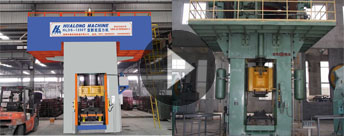
Precision gentle pressure carbon-locking and toughness-preserving - Specialized servo screw press forming solution for carbon composite refractory bricks
Author: haloong Time: 2026-05-06 15:12:39
The service life and adaptability to working conditions of carbon composite refractory bricks are entirely dependent on the density of the green body, the interlayer bonding strength, and the integrity of the carbon microstructure during the forming stage. The forming of high-quality carbon composite refractory bricks must strictly meet three core process requirements: first, the density must be highly uniform throughout the entire body, with the overall density of the green body meeting the standard and the density deviation within the same batch being extremely small, eliminating local loose and dense areas, laying a solid foundation for the stable mechanical properties and erosion resistance of the finished product after sintering; second, the carbon structure must be intact without damage, and the pressure application process must avoid rigid impacts to prevent the separation of carbon powder and aggregates, as well as the fracture of the carbon skeleton, preserving the natural toughness and thermal conductivity advantages of the carbon material; third, low-pressure and slow-speed exhaust and stable pressure forming must be adopted, adapting to the poor air permeability of the carbon composite mixture, the easy segregation of powder materials, and the easy loss of binders, slowly expelling the internal air of the green body to avoid residual pores and delamination and cracking of the green body. In contrast, traditional friction presses and ordinary hydraulic presses have common shortcomings such as rough pressure application, large pressure fluctuations, uneven pressure transmission, and strong impact, frequently resulting in problems such as interlayer separation of carbon composite bricks, material loss at the edges and corners, internal microcracks, large fluctuations in product quality within the same batch, and low qualified product rates in production. This not only increases raw material waste and rework costs but also leads to frequent shutdowns and maintenance of terminal kiln equipment, significantly increasing the comprehensive operating costs of enterprises. Zhengzhou Hualong focuses on the specialized forming needs of carbon composite refractory bricks, reconstructing the forming logic with servo direct drive core technology, ensuring that the forming of carbon composite refractory bricks is both dense and uniform, while protecting the original toughness of the carbon material.
The raw material system of carbon composite refractory bricks is special, consisting of high-hardness refractory aggregates, ultra-fine carbon powder, and special organic binders. The material density differences are significant, the adhesion of carbon components is weak, and the exhaust of the mixture is difficult. The forming process has a very low tolerance rate, and the structural defects of traditional refractory forming equipment are prominent.
Relying on 45 years of research and development experience in refractory forming equipment, Zhengzhou Hualong has deeply explored the core logic of the forming process of carbon composite refractory bricks. With the core technology of permanent magnet synchronous servo direct drive system + static pressure flexible pressure transmission structure + carbon brick dedicated intelligent numerical control system, it has specifically optimized and upgraded the HLDS series of servo screw presses. The six core advantages precisely match the all-round forming requirements of carbon composite refractory bricks, including carbon protection, uniform density, exhaust, stable production, energy conservation, and adaptability, fundamentally solving the industry's forming pain points and assisting enterprises in mass-producing high-quality, long-life carbon composite refractory bricks.
The equipment is equipped with Hualong's third-generation permanent magnet synchronous servo direct drive core system, eliminating the traditional coarse transmission structures such as friction discs and clutches. Energy transmission is loss-free, and the pressure output is fully controllable, with a repeat control accuracy of the forming energy of ≤±1%. A specially customized stepwise flexible pressure application process for carbon composite bricks is available, allowing for precise digital setting of the parameters for pre-pressing and exhaust, staged pressure application, and stable pressure maintenance and shape preservation throughout the process. It first applies low-speed light pressure to slowly expel the internal air of the mixture, then applies uniform and stable pressure to gradually compact the green body layer by layer. Throughout the process, there is no sudden rigid impact, gently protecting the composite structure of carbon powder and aggregates from damage, eliminating problems such as carbon layer separation, internal microcracks, and carbon skeleton fractures, and fully preserving the high toughness and high thermal shock resistance of carbon composite refractory bricks.
It adopts a fully enclosed static pressure screw and nut heavy-load transmission structure, forming a stable high-pressure oil film buffer protection throughout the operation, achieving flexible and uniform force transmission and slow pressure application. The pressure is evenly distributed to every part of the green body, completely solving the problem of local pressure imbalance in traditional equipment. It ensures that the density of the carbon composite refractory brick green body is highly uniform in the center, edges, and corners, with the apparent porosity stably controlled within the standard range, and the density is uniformly up to standard. After sintering, the finished product structure is dense without porosity, effectively resisting the erosion of high-temperature steel slag and chemical corrosion, significantly extending the service life of the refractory brick kiln, and reducing the frequency of terminal equipment maintenance. Breaking through the structural limitations of the fixed bottom dead center of traditional forming equipment, it adopts a successive flexible forging forming mode. According to the different carbon content ratios, specifications, and complexity of the special-shaped structures of carbon composite bricks, it can flexibly and precisely adjust the stroke of the slider, the depth of pressure application, and the forming force, perfectly adapting to the forming of all types of products such as standard carbon composite bricks, special-shaped carbon refractory bricks, and high-temperature furnace-specific special-shaped carbon bricks. Coupled with a rapid mold change structure, the mold change is convenient and efficient, without the need for repeated adjustment of equipment parameters, easily meeting the production needs of multiple varieties and batch switching, and accommodating both large-scale mass production and customized processing scenarios.
The equipment is equipped with a dedicated forming process database for carbon composite refractory bricks, with the optimal forming parameters for various types of standard, special-shaped, and high and low carbon content carbon composite bricks pre-entered, covering core data such as pressure application speed, holding time, striking times, and forming pressure. Operators can directly retrieve and start production with a single click, eliminating the need for repeated manual trial and error. All process parameters can be permanently stored and reused in batches, completely avoiding quality fluctuations caused by differences in manual operation experience, ensuring that the quality, density, and structural consistency of each batch of carbon composite refractory brick blanks are maximized, and the product qualification rate is stably increased to over 99%.
It adopts a servo motor on-demand start-stop intelligent energy-saving mode, with the motor only running during the pressing and forming process, and remaining in a dormant state with zero energy consumption during the feeding, demolding, and standby processes. Compared with traditional friction presses, the comprehensive energy-saving rate is over 55%, significantly reducing the electricity cost for enterprise production. The static pressure transmission structure has extremely low wear, and is equipped with a fully automatic forced lubrication and oil shortage alarm protection system, resulting in a low equipment failure rate and a long replacement cycle for vulnerable parts, reducing the later maintenance cost by over 40%. This not only aligns with the green and low-carbon development policies of the refractory materials industry but also comprehensively reduces the comprehensive production and maintenance costs, enhancing the profit space of enterprises.
The equipment is standardly equipped with industrial communication interfaces, seamlessly integrating with automatic feeding machines, precise material distribution machines, intelligent demolding machines, and blank inspection and conveying lines to build a fully automated unmanned forming production line for carbon composite refractory bricks. Throughout the process, manual intervention is minimized, avoiding damage to the blanks due to manual operation and affecting the forming accuracy. It also supports remote production monitoring, remote parameter adjustment, intelligent fault warning, and full traceability of production data, meeting the digital and intelligent transformation and upgrading needs of domestic and foreign refractory material enterprises, achieving high-quality, high-efficiency, and standardized intelligent manufacturing of carbon composite refractory bricks.
Zhengzhou Hualong Machinery, as a leading domestic core R&D and manufacturing enterprise of servo screw presses, has been focusing on the technological innovation of refractory material forming equipment for 45 years, deeply exploring the forming processes of high-end composite refractory materials such as carbon composite refractory bricks. It adheres to solving industry production pain points with customized equipment technology. The Hualong HLDS series of servo screw presses cover tonnages from 200T to 1600T, and can provide one-to-one customized overall forming solutions based on customers' raw material ratios, product specifications, production capacity requirements, and quality standards for carbon composite bricks, fully meeting the high-quality mass production needs of various types of carbon composite refractory bricks.


