



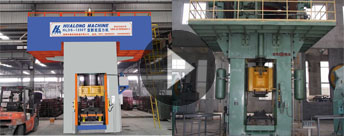
Driving Fastener Industry Upgrading: The Indispensable Role of Precision Forging Presses
Author: haloong Time: 2025-12-20 08:45:04
In recent years, the global fastener industry has been facing an unprecedented wave of upgrading, driven by the increasing demand for high-performance, high-precision, and lightweight components from downstream sectors such as aerospace, automotive, high-speed rail, and wind power. Fasteners, as the "linkage" of industrial manufacturing, their quality and performance directly affect the safety and reliability of end products. Amid this transformation, precision forging presses have emerged as an indispensable core equipment, providing strong technical support for the upgrading and development of the fastener industry.
Precision forging presses are the core carrier for the forming and processing of high-quality fasteners. Unlike traditional processing methods, precision forging presses can realize one-time or multi-pass forming of fastener blanks through cold heading or hot heading forging processes. They can provide stable pressure output and precise stroke control, ensuring that metal wires or bars are extruded into the required shapes in the mold. This not only improves the material utilization rate to more than 80%, reducing material waste and production costs, but also retains the metal fiber streamline of the fasteners, significantly enhancing their mechanical properties such as tensile strength and fatigue resistance. For high-strength fasteners used in key fields, this forming method is even more irreplaceable.
The high precision and stability of precision forging presses are the key guarantees for improving the quality of fasteners. With the upgrading of downstream industries, the requirements for fastener dimensional tolerance, coaxiality, and surface finish are becoming increasingly strict. A slight deviation may lead to assembly failures and potential safety hazards. Advanced precision forging presses are equipped with high-precision guiding mechanisms, servo control systems, and precise mold positioning technologies, which can strictly control the deformation and dimensional errors during the forging process. This ensures the consistency of each batch of fasteners, effectively avoids defects such as cracking and necking caused by unstable pressure, and lays a solid foundation for fasteners to enter high-end markets.
Precision forging presses also show strong adaptability in meeting the diverse production needs of the fastener industry. The fastener market covers a wide range of products, from small standard fasteners such as M2-M10 bolts to large high-strength fasteners such as wind power bolts and engineering machinery nuts, as well as special-shaped fasteners with complex structures. For different types of fasteners, precision forging presses can be adjusted and optimized in terms of forging force, speed, and stroke. For example, high-speed precision cold heading presses are suitable for the efficient mass production of small standard fasteners, with a production capacity of hundreds of pieces per minute; servo hydraulic precision forging presses can provide large forging force to meet the forming needs of high-hardness steel for large fasteners; for special-shaped fasteners, the flexible control system of precision forging presses can cooperate with customized molds to complete complex shape forging, realizing the diversified production of fasteners.
In addition, the technological iteration of precision forging presses is also promoting the transformation and upgrading of the fastener industry towards intelligence and high value-added. With the integration of technologies such as servo drive, intelligent monitoring, and Internet of Things, modern precision forging presses can realize real-time monitoring of the forging process, automatic adjustment of parameters, and predictive maintenance of equipment. This not only improves production efficiency and reduces manual intervention, but also helps fastener manufacturers to better control production quality and reduce production risks. At the same time, the continuous progress of precision forging press technology has also supported the application of new materials such as titanium alloys and high-strength alloy steels in the fastener industry, helping enterprises to break through the bottleneck of traditional materials and develop high-end customized fastener products, thereby improving product added value and market competitiveness.
In conclusion, the upgrading of the fastener industry cannot be separated from the strong support of precision forging presses. As the core equipment in the fastener production process, precision forging presses have become an important driving force for the fastener industry to move towards high precision, high efficiency, diversification, and intelligence with their advantages in precision, stability, adaptability, and intelligence. In the future, with the continuous development of downstream industries, the demand for high-quality fasteners will continue to grow, which will further promote the technological innovation of precision forging presses. The coordinated development of the two will surely inject new vitality into the global manufacturing industry.


