



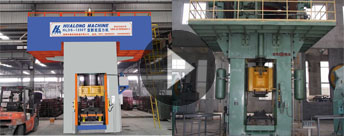
How Precision Forging Presses Boost the Quality of Rail System Components
Author: haloong Time: 2025-12-23 16:59:04
Rail system components, as the core support of rail transit operation, have stringent requirements for strength, precision, and durability. Precision forging presses, with their advanced servo control technology, high-precision forming capabilities, and flexible process adaptation, have become a key driving force in improving the quality of rail system components. This article explores the multiple ways in which precision forging presses enhance the quality of rail components, including optimizing material properties, ensuring dimensional accuracy, and improving production stability, and discusses their important role in promoting the high-quality development of the rail transit industry.
1. Core Ways for Precision Forging Presses to Improve the Quality of Rail Components
1.1 Optimizing Material Properties to Enhance Component Strength and Durability
The quality of rail components is fundamentally determined by the properties of the materials used. Precision forging presses adopt advanced forming technologies such as near-net shaping and controlled forming, which can effectively optimize the metal flow of the material during the forging process. Compared with traditional forging methods, precision forging presses apply pressure more uniformly and controllably, ensuring that the metal grains are refined and the material structure is more dense. This not only improves the tensile strength, yield strength, and hardness of the rail components but also enhances their wear resistance and fatigue resistance.
For example, in the forging of rail fastener bolts and springs, precision forging presses can ensure the integrity of the metal flow line, avoiding the occurrence of internal defects such as pores and cracks in the components. This enables the fasteners to maintain stable performance under long-term vibration and load, reducing the risk of loosening or failure and thus improving the safety and service life of the entire rail system.
1.2 Ensuring Dimensional Accuracy to Meet Standardized Production Requirements
Rail system components have extremely strict requirements for dimensional tolerance. Even minor deviations may lead to poor assembly of components, affecting the normal operation of the rail system. Precision forging presses are equipped with high-precision servo control systems and advanced detection and feedback devices, which can achieve precise control of the forging process parameters such as pressure, slider stroke, and forming speed.
During the forging process, the servo control system can real-time monitor and adjust the operation parameters of the press according to the preset process requirements, ensuring that the dimensional error of the forged parts is within the allowable range. For complex-shaped rail components such as turnout frogs and switch rails, precision forging presses can accurately replicate the mold shape, ensuring the consistency of the shape and size of each component. This not only meets the standardized production requirements of rail components but also reduces the subsequent machining workload, improving production efficiency while ensuring quality.
1.3 Improving Production Stability to Ensure Consistent Quality
The stability of the production process is an important guarantee for the consistent quality of rail components. Traditional forging equipment is easily affected by factors such as hydraulic pressure fluctuations and mechanical wear, leading to large differences in the quality of forged parts produced in different batches. Precision forging presses, on the other hand, adopt electric servo drive technology, which has higher stability and reliability.
The electric servo drive system can provide stable and continuous power output, avoiding the impact of hydraulic oil leakage, temperature changes, and other factors on the forging process. At the same time, the intelligent control system of precision forging presses can realize the automatic monitoring and early warning of the production process. Once an abnormal parameter is detected, the system can immediately stop the machine and alarm, preventing the production of unqualified products. This high production stability ensures that the quality of rail components remains consistent in large-scale production, laying a solid foundation for the batch application of high-quality rail components.
2. Conclusion
In the context of the continuous upgrading of rail transit technology, the quality requirements for rail system components are becoming increasingly strict. Precision forging presses, with their unique advantages in optimizing material properties, ensuring dimensional accuracy, and improving production stability, play an irreplaceable role in boosting the quality of rail components. They not only promote the upgrading of the rail component manufacturing industry but also provide a strong guarantee for the safe, efficient, and high-quality operation of global rail transit.
In the future, with the continuous innovation and development of precision forging technology, precision forging presses will be more intelligent, efficient, and environmentally friendly. They will better adapt to the personalized and high-precision production needs of rail components, contributing more to the sustainable development of the rail transit industry.


