



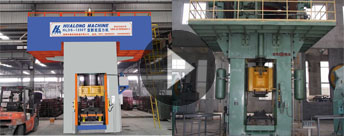
Precision Forging Presses in Lightweight Component Manufacturing: Case Studies
Author: haloong Time: 2025-12-24 09:24:58
In the era of global manufacturing upgrading, lightweighting has become a core pursuit in industries such as automotive, aerospace, and new energy. Lightweight components not only reduce energy consumption and improve operational efficiency but also meet the increasingly stringent environmental protection standards. As a key piece of equipment in the production of high-precision lightweight parts, precision forging presses play an irreplaceable role. This article explores the application value of precision forging presses in lightweight component manufacturing through two typical industrial cases, analyzing their technical advantages and practical effects in optimizing production processes and improving product quality.
1.Precision Forging of Aluminum Alloy Automobile Chassis Components
A leading global automotive parts manufacturer aimed to reduce the weight of its automobile chassis while ensuring structural strength and safety. Aluminum alloy, with its high strength-to-weight ratio, was selected as the core material. However, the forming of aluminum alloy chassis components requires strict control of dimensional accuracy and internal tissue uniformity, as any slight deviation may affect the overall performance of the chassis.
The manufacturer adopted a high-precision hydraulic forging press in the production process. This press is equipped with an advanced servo control system that can achieve real-time adjustment of forging force and speed, with a dimensional accuracy error of less than ±0.01mm. During the forging process, the press precisely controls the deformation of the aluminum alloy blank, avoiding defects such as cracks and uneven density caused by excessive or uneven force application. Additionally, the press integrates an online detection module that monitors the key dimensions of the workpiece in real time during the forming process, ensuring that each component meets the design requirements.
The application of the precision forging press achieved remarkable results: the weight of the aluminum alloy chassis components was reduced by 35% compared to traditional steel components, while the structural strength increased by 12%. At the same time, the production qualification rate rose from 89% to 99.2%, and the production efficiency was improved by 40% due to the reduction of post-processing procedures. This not only helped the manufacturer reduce production costs but also enhanced the competitiveness of its products in the lightweight automotive market.
2. Titanium Alloy Forging for Aerospace Lightweight Parts
In the aerospace industry, the lightweighting of components is crucial for reducing the take-off weight of aircraft and improving fuel efficiency. Titanium alloy is widely used in the production of aerospace lightweight parts due to its excellent high-temperature resistance and lightweight properties. However, titanium alloy has poor plasticity at room temperature, making it difficult to form, and requires high-precision forming equipment to ensure product quality.
An aerospace component manufacturer introduced a precision mechanical forging press with multi-stage pressure regulation function. This press can adjust the forging pressure according to the different deformation stages of titanium alloy, realizing gradual forming of the blank. It is also equipped with a high-temperature heating system that maintains the titanium alloy blank at an optimal forming temperature (800-900℃) during the forging process, improving the plasticity of the material and reducing forming resistance.
Through the application of this precision forging press, the manufacturer successfully produced titanium alloy aerospace components with complex structures and high precision. The dimensional accuracy of the components reached IT5 level, and the internal tissue was uniform without defects such as porosity and segregation. The weight of the finished parts was 28% lighter than that of traditional nickel-based alloy parts, and the high-temperature performance fully met the aerospace industry standards. This case proves that precision forging presses can effectively solve the forming problems of difficult-to-deform materials such as titanium alloy, providing reliable technical support for the lightweight development of the aerospace industry.
Conclusion
The above two cases fully demonstrate that precision forging presses are the core equipment to promote the lightweight development of manufacturing industries. With their high precision, high efficiency, and flexible process control capabilities, they can effectively solve the technical difficulties in the forming of lightweight materials such as aluminum alloy and titanium alloy, improving product quality and production efficiency while reducing production costs. As the demand for lightweight components in various industries continues to grow, precision forging presses will face broader development prospects. In the future, with the integration of intelligent technologies such as Internet of Things and artificial intelligence, precision forging presses will move towards a more intelligent and automated direction, further promoting the upgrading of the global lightweight manufacturing industry.


