



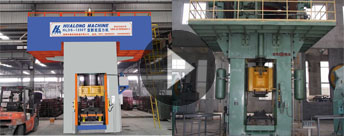
Servo Press vs. Traditional Equipment: A Cost-Benefit Analysis for Clay Brick Manufacturers
Author: haloong Time: 2025-12-25 11:54:19
In the clay brick manufacturing industry, the choice of forming equipment directly affects production efficiency, product quality, and long-term operational costs. Traditional forming equipment, such as friction presses and hydraulic presses, has long dominated the market due to its mature technology. However, with the continuous advancement of servo technology, servo presses have gradually emerged as a preferred option for many manufacturers pursuing high efficiency and cost optimization. This article conducts a comprehensive cost-benefit analysis of servo presses and traditional equipment to provide practical reference for clay brick manufacturers in equipment selection.
1. Production Efficiency: Output and Precision Advantages
Production efficiency is a core factor determining the profitability of clay brick manufacturers. Traditional friction presses rely on mechanical transmission, which has the disadvantages of low speed regulation accuracy and long idle stroke time. In actual production, the forming cycle of a single clay brick is usually 8-12 seconds, and the speed is difficult to adjust according to the characteristics of different clay materials, leading to uneven production efficiency.
In contrast, servo presses adopt servo motor-driven technology, which realizes stepless speed regulation and precise stroke control. The forming cycle of a single clay brick can be shortened to 4-6 seconds, and the production capacity can be increased by 50% or more compared with traditional equipment. Moreover, the servo system can automatically adjust the pressure and speed according to the moisture content and viscosity of the clay, ensuring the consistency of each brick's density and shape. This not only reduces the rejection rate (the rejection rate of traditional equipment is usually 5-8%, while that of servo presses is less than 2%) but also improves the qualification rate of high-grade clay bricks, thereby enhancing the product's market competitiveness.
2. Energy Consumption: Significant Cost Savings in Long-Term Operation
Energy consumption accounts for a large proportion of the operational costs of clay brick production. Traditional equipment has inherent defects in energy utilization: friction presses have high mechanical wear, and the energy loss during transmission is as high as 30-40%; hydraulic presses need to maintain high-pressure oil circulation for a long time, even in the idle state, resulting in continuous energy consumption. According to industry statistics, the average energy consumption of traditional equipment per 10,000 clay bricks is 80-100 kWh.
Servo presses, on the other hand, adopt a "demand-driven" energy supply mode. The servo motor only consumes energy when it is working, and there is almost no energy loss during the idle period. At the same time, the high-precision transmission system reduces mechanical friction loss, making the energy utilization rate reach more than 90%. The actual measurement shows that the energy consumption of servo presses per 10,000 clay bricks is only 30-45 kWh, which can save 40-60% of energy costs compared with traditional equipment. For a medium-sized clay brick factory with an annual output of 10 million bricks, the annual energy cost savings can reach tens of thousands of US dollars, which is a significant reduction in long-term operational costs.
3. Maintenance Costs: Reduced Downtime and Lower Repair Expenses
The maintenance cost and downtime of equipment directly affect the continuity of production. Traditional equipment has complex structures and many easily worn parts: friction presses need to frequently replace friction plates, bearings, and other parts, and the maintenance cycle is usually 1-2 months; hydraulic presses are prone to oil leakage, and the maintenance of hydraulic cylinders and pipelines requires professional technicians, resulting in high maintenance costs and long downtime (average downtime per year is 30-50 hours).
Servo presses have a simpler structure, with fewer mechanical transmission parts and no hydraulic oil circulation system, thus greatly reducing the probability of failures. The servo motor and control system have high stability, and the maintenance cycle can be extended to 6-12 months. Even if maintenance is needed, the operation is simple, and ordinary technicians can complete it after simple training. The annual downtime of servo presses is usually less than 10 hours, and the annual maintenance cost is only 20-30% of that of traditional equipment. This not only reduces repair expenses but also ensures the continuity of production, avoiding losses caused by production suspension.
4. Initial Investment: Balancing Short-Term Costs and Long-Term Returns
It should be acknowledged that the initial investment cost of servo presses is higher than that of traditional equipment. The price of a servo press of the same specification is usually 30-50% higher than that of a friction press or hydraulic press. This may make some small and medium-sized manufacturers hesitate in the short term.
However, from the perspective of long-term returns, the cost advantage of servo presses is obvious. Taking a medium-sized clay brick factory as an example, the additional initial investment of servo presses can be recovered through energy savings and efficiency improvement within 1.5-2 years. After that, the continuous reduction of energy consumption and maintenance costs will bring stable profit growth to the enterprise. In addition, with the increasing emphasis on environmental protection and energy conservation in various countries, servo presses, as energy-saving and environmentally friendly equipment, are more likely to meet policy requirements, avoiding the risk of being eliminated due to environmental protection issues, which is an intangible long-term benefit.
Conclusion
In the cost-benefit comparison between servo presses and traditional equipment for clay brick manufacturing, servo presses show obvious advantages in production efficiency, energy consumption, and maintenance costs, despite the higher initial investment. For clay brick manufacturers aiming to improve product quality, reduce operational costs, and achieve sustainable development, servo presses are a more cost-effective choice in the long run.
When selecting equipment, manufacturers should not only focus on the short-term investment but also comprehensively consider the long-term operational benefits, combined with their own production scale, product positioning, and policy requirements. With the continuous maturity of servo technology and the gradual reduction of equipment prices, servo presses will surely become the mainstream equipment in the clay brick manufacturing industry, promoting the transformation and upgrading of the industry towards high efficiency, energy conservation, and intelligence.


