



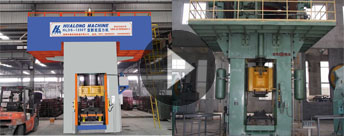
Unlocking the Process Potential of Closed Die Steel Forgings with Precision Forging Presses
Author: haloong Time: 2025-12-29 17:06:11
Closed die steel forgings have become the backbone of high-performance components across heavy machinery, automotive, aerospace, and energy sectors, thanks to their exceptional structural integrity, wear resistance, and dimensional accuracy. However, the full realization of these advantages hinges on the core equipment that drives the forging process—precision forging presses. As the technological core of closed die forging, precision forging presses bridge the gap between raw metal blanks and high-quality finished parts, unlocking the inherent process potential of closed die steel forgings through advanced design, precise control, and reliable performance.
The production of closed die steel forgings demands rigorous process conditions: sufficient pressure to fill complex die cavities, precise temperature control to avoid material defects, and stable operation to ensure consistency in batch production. Precision forging presses are engineered to meet these demands with remarkable capabilities. Equipped with high-rigidity frames and heavy-duty drive systems, they deliver concentrated and stable forging force, ensuring that metal blanks—whether carbon steel, alloy steel, or special-grade steel—flow uniformly within closed dies to form intricate geometries. Unlike conventional equipment, modern precision forging presses integrate servo control technology, enabling real-time adjustment of forging speed, pressure, and stroke. This not only minimizes material waste caused by uneven deformation but also optimizes the internal grain structure of forgings, enhancing their mechanical properties such as tensile strength and fatigue resistance.
Another key advantage of precision forging presses lies in their ability to support efficient and intelligent production of closed die steel forgings. In today’s manufacturing landscape, batch production and cost control are critical for industry competitiveness. Precision forging presses feature fast cycle times and high repeatability, reducing production lead times while maintaining consistent part quality. Moreover, they can be seamlessly integrated with automated systems—including robotic loading/unloading arms, temperature monitoring devices, and data tracking modules—forming fully automated production lines. This integration not only reduces labor dependency and human error but also enables full-process data recording and traceability. Manufacturers can monitor key parameters such as forging temperature, pressure distribution, and die wear in real time, facilitating predictive maintenance and continuous process optimization. For closed die steel forgings used in high-demand sectors like aerospace and defense, this level of process control and traceability is indispensable for meeting stringent quality standards.
The versatility of precision forging presses further expands the application boundaries of closed die steel forgings. Whether producing large-scale components for heavy engineering (such as hydraulic support columns and pressure vessel bottoms) or small, high-precision parts (like automotive gears and aerospace fasteners), precision forging presses can be customized to match specific process requirements. For example, warm forging-capable precision presses balance temperature and pressure to improve material fluidity, reducing oxidation and scaling on forging surfaces; while servo-driven models offer flexible stroke adjustment, enabling multi-step forming in a single machine. This adaptability allows manufacturers to tackle diverse product portfolios with a single set of core equipment, lowering investment costs and enhancing market responsiveness.
In an era where manufacturing is evolving toward higher precision, efficiency, and sustainability, precision forging presses are no longer just production tools—they are enablers of innovation for closed die steel forgings. By overcoming the limitations of traditional forging equipment, they unlock the process potential of closed die steel forgings in terms of quality, efficiency, and versatility. As industries continue to demand components that are stronger, lighter, and more reliable, the role of precision forging presses will only grow in importance. They not only drive the advancement of closed die steel forging technology but also empower manufacturers to meet the evolving needs of global markets, laying a solid foundation for the development of high-end manufacturing.


